
Types of Acoustic Panels: Cost, Placement & Uses
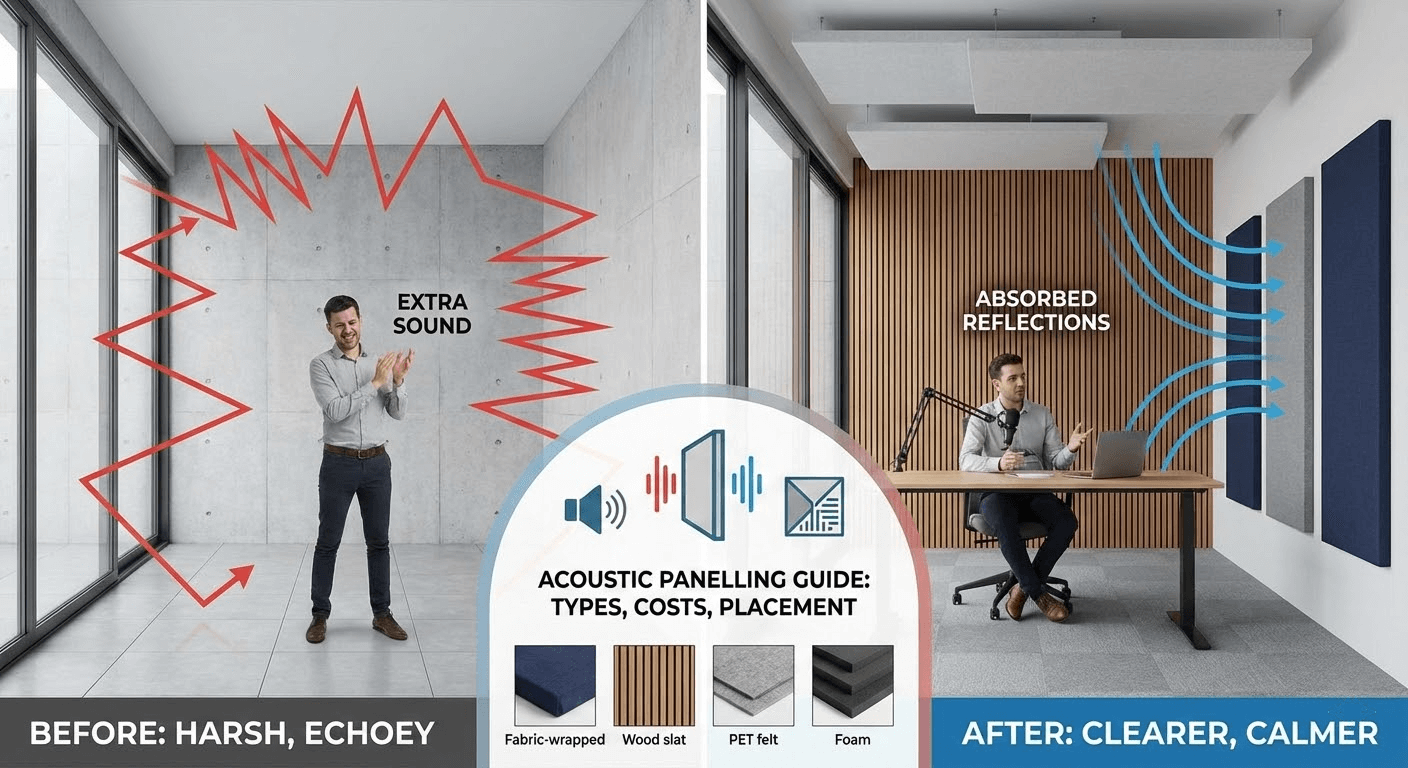
If a room feels harsh, tiring, or echoey, the room is adding extra sound. Acoustic panelling helps by absorbing reflections so speech becomes clearer and the space feels calmer.
This guide explains what is acoustic panelling with real-world choices: common types, realistic costs, and where to place panels for the biggest impact.
A quick 5-minute check
-
Clap once. A sharp ring or long tail suggests strong reflections.
-
List your hard surfaces: glass, bare drywall, tile, concrete.
-
Pick your goal: better clarity in the room, or less sound leaking to other rooms.
What Is Acoustic Panelling and How It Works
Acoustic panelling means wall or ceiling treatments designed to absorb sound energy inside a room, reducing echo and reverberation. Reverberation time is widely described as the time it takes for sound level to drop by 60 dB after the source stops.
Two specs keep you from buying the wrong product:
-
NRC is a single-number absorption rating. Under ASTM C423 reporting, NRC is calculated as the average absorption at 250, 500, 1000, and 2000 Hz, rounded to 0.05.
-
STC relates to sound passing through building elements, which is a different problem than echo control inside a room.
Practical note: better placement usually beats adding more panels.
Types of Acoustic Panelling
The best type depends on aesthetics, durability, and documentation, plus how quickly you need results.
Fabric-wrapped fiberglass or mineral wool panels
A reliable choice for offices, meeting rooms, restaurants, classrooms, and home studios. A city residential noise control guidance sheet recommends acoustic panels to absorb excess reverberant sound indoors and suggests looking for high NRC when selecting panels.
Wood slat acoustic panels
These combine a wood face with a porous backing so sound can reach absorbent material behind the slats.
They work well for feature walls and hospitality spaces where design matters.
PET felt and polyester fiber panels
Lightweight, easy to cut, and common in commercial interiors. Good for speech-focused spaces when you want fast installation.
Foam panels and tiles
Foam can reduce flutter echo in small rooms, yet performance and fire documentation vary widely.
Costs and Budget Planning for Acoustic Panelling
Prices swing based on finish level and compliance needs, so budgeting in ranges is safer than chasing a single number.
What drives cost
-
Core and thickness
-
Facing and edge finish
-
Fire and documentation requirements
-
Mounting system and labor
Two price anchors
-
Wood slat retail kits can be around $6.14 per square foot in big-box listings.
-
A 48"×24"×2" fabric-wrapped panel can be roughly $84.95 on a common direct-to-consumer listing, before shipping and hardware.
A performance benchmark you can reference
ANSI classroom guidance is commonly summarized as maximum reverberation times of 0.6 seconds for smaller classrooms and 0.7 seconds for mid-sized classroom volumes.
Placement and Coverage: Where to Put Acoustic Panelling
Placement usually decides whether people feel a difference.
The high-impact placement sequence
-
Treat the wall behind the listeners.
-
Treat the wall behind the main talker or screen.
-
Add ceiling coverage over the table or main seating zone.
-
Add side-wall panels at first reflection points (the mirror trick works well).
How much coverage to start with
A practical starting recommendation for offices and conference rooms is often around 15–20% coverage focused on key reflection zones and ceiling clouds.
Many rooms land in a 15–30% coverage band across walls and ceiling once the goal is clear.
A simple upgrade that can boost performance
An air gap behind an absorbing panel is well known to extend effectiveness to a lower frequency.
If the room sounds boxy, a small gap can be a high-value tweak when your mounting method allows it.
Acoustic Panelling vs Soundproofing
Acoustic panelling improves the sound inside a room by absorbing reflections. Soundproofing aims to reduce sound transmission using heavier assemblies and sealing details.
INCE-USA highlights a frequent misconception: porous, lightweight acoustic panels absorb sound, and they do not block sound transmission in the way isolation assemblies do.
If the complaint is “I hear the next room,” focus first on doors, gaps, and wall assemblies, then add panels for comfort and clarity.
Buying Tips for Bulk and Trade Customers
Bulk buyers often care about repeatability, documentation, and installation speed.
Spec sheet items to request
-
NRC and the test context, commonly tied to ASTM C423 reporting.
-
Fire documentation. ASTM E84 is used to evaluate comparative surface burning behavior for exposed wall and ceiling finishes.
-
Cleaning method and durability
-
Mounting hardware details and a plan for replacements
Procurement shortcuts that save headaches
-
Standardize panel sizes across rooms for easier spares.
-
Order a small overage for future repairs and matching.
-
Confirm lead times early when coordinating with AV and lighting.
Wellco Wholesale positions itself as a one-stop wholesale supplier for bulk purchasing across categories like garden, farm, hotel, and light building supplies. For trade customers sourcing multiple items for a project, consolidating vendors can simplify logistics and purchasing workflows.
Installation and Maintenance Basics
Mounting options include clips for removability, adhesives for speed, and suspension systems for ceiling clouds. For commercial interiors, request the relevant fire test report and classification for interior wall and ceiling finishes under the applicable standard.
For maintenance, vacuum fabric faces with a soft brush, follow the manufacturer’s cleaning guidance, and keep spares for high-contact areas.
Conclusion
Acoustic panelling is a straightforward way to reduce echo and improve speech clarity when you choose the right panel type and treat the right reflection zones first. Start with the rear wall and ceiling over the main activity area, then add side-wall reflections as needed. If you are buying for multiple rooms, collect NRC and fire documentation early, standardize sizes, and plan spares so future replacements match.
Frequently Asked Questions
What is acoustic panelling used for in offices?
It is commonly used to reduce echo and improve speech clarity in meetings and calls. A typical starting point is targeted treatment around key reflection zones rather than full-room coverage.
Will acoustic panelling stop my neighbor’s noise?
It generally will not solve sound traveling through walls, ceilings, or floors. Isolation relies on sealing and heavier construction details, while panels focus on controlling reflections inside the room.
How do I choose between wood slat panels and fabric panels?
Wood slat systems often rely on porous backing behind the slats for absorption and deliver a strong design look.
Fabric panels are a straightforward path to high absorption when performance is the priority.
Do I need an air gap behind panels?
An air gap can extend porous panel effectiveness to lower frequencies.
If you have the space and the mounting system supports it, it is often worth considering.