
Radiant Barrier Attic Foil Reflective Insulation Guide
A radiant barrier attic foil reflective insulation upgrade targets the most punishing type of attic heat: radiant heat pouring off a sun-heated roof deck. If you’ve ever crawled into an attic in late afternoon and felt the heat “radiate” at you even before you touch anything, that’s the load this product is meant to reduce.
This article is written for trade buyers (roofers, HVAC contractors, insulation crews, property managers) and practical homeowners who want a real-world guide: what to spec, how to install it without killing performance, what savings are realistic, and what safety/code issues you can’t ignore.
Quick reality check from the field: the most common reason radiant barriers “don’t work” is not the foil—it’s the attic. I’ve walked attics where the foil was perfectly stapled up, but soffits were blocked by insulation and ducts were leaking like a sieve. Fix those two issues and you usually feel the difference faster than any single product swap.
Who / How / Why (Transparency Box)
-
Who this is for: Bulk and trade purchasers plus DIYers managing hot-attic comfort and cooling load.
-
How this guide was created: Building-science fundamentals + Department of Energy and Building America guidance + manufacturer technical specs; combined with jobsite-style installation checks.
-
Why it exists: To help buyers choose and install radiant barrier products correctly—without inflated promises or “one weird trick” claims.
How Radiant Heat Works in an Attic
Radiation vs. conduction vs. convection (plain-English)
-
Radiation: infrared energy traveling from a hot surface (roof deck) to cooler surfaces (attic floor, ducts).
-
Conduction: heat moving through solids (wood framing, drywall).
-
Convection: heat moving with air currents (hot attic air mixing and leaking).
A radiant barrier works because its shiny surface has low emittance—it doesn’t “give off” much radiant heat, and it reflects a large portion of radiant energy across an air space. The U.S. Department of Energy explains that radiant barriers reduce radiant heat transfer from the underside of the roof to attic surfaces and are most effective in warm, sunny climates, especially when HVAC ducts are in the attic.
Why attics get so hot (and why ducts pay the price)
On a sunny day, the roof deck can get extremely hot and acts like a radiator facing downward. If ducts run through the attic, they’re exposed to:
-
Radiant heating from the roof deck and hot framing
-
Hot ambient attic air
-
Losses at leaky joints (conditioned air leaking out + hot air being drawn in)
That’s why many contractors prioritize duct sealing and insulation alignment alongside radiant barriers.
Where foil fits in the “whole-house” strategy
Radiant barrier is a heat-gain reducer, not a replacement for insulation or air sealing. In most retrofits, the most reliable sequence is:
-
Air seal ceiling penetrations (top plates, can lights, chases)
-
Bring insulation to target R-value (and even coverage)
-
Confirm ventilation pathways (don’t block soffit intake / ridge exhaust)
-
Add radiant barrier attic foil reflective insulation where conditions are favorable
Radiant Barrier Attic Foil Reflective Insulation: What to Look For
Product types you’ll see (and who they suit)
-
Perforated foil radiant barriers: common choice in vented attics; allows moisture vapor movement more readily.
-
Foil-scrim (reinforced) products: easier to handle, more tear-resistant for crews.
-
Foil bubble / “reflective insulation”: sometimes useful in specific assemblies, but often unnecessary for standard attic radiant-barrier retrofits where a single foil layer across rafters does the job.
Specs that matter more than the label
1) Low emittance: Many code/education resources call out low emittance as the key performance requirement (often ≤ 0.05). When comparing products, rely on published test data rather than marketing adjectives like “super reflective.”
2) Fire classification and intended use: Product tech sheets typically list fire testing/classification and installation limitations. Treat these as non-negotiable purchasing criteria, especially for commercial or multi-family work.
3) Reinforcement and jobsite durability: If crews will be crawling for service access, reinforced foil-scrim tends to hold up better than thin foil.
Why ASTM/testing mentions aren’t just “nerd stuff”
You’ll see emissivity/reflectivity tied to ASTM test methods (e.g., ASTM C1371 / E408) in technical documentation and code-adjacent guidance. The practical takeaway: testing provides a comparable number across products, which matters when you’re buying pallets and need consistency across jobs.
A Quick Decision Framework for Buyers
Use this as a fast “spec it / don’t spec it” checklist.
When a radiant barrier is usually a good bet
-
Hot, sunny climate and long cooling season (or persistent comfort complaints)
-
Ductwork in the attic (especially if not buried/encapsulated)
-
Low roof shading and dark roofing
-
Attic access allows correct installation without blocking ventilation
DOE notes radiant barriers are most effective in warm, sunny climates and often show the greatest benefit when ducts are in the attic.
When it’s often lower priority
-
Mild climates with short cooling season
-
Already excellent attic performance: sealed ceiling plane, high insulation, good ventilation, ducts conditioned or well protected
-
Complicated framing where maintaining air space and ventilation paths would be difficult
Perforated vs. non-perforated (rule-of-thumb)
-
Vented attics: perforated is commonly chosen to reduce moisture concerns.
-
Non-vented/conditioned attic assemblies: follow building-science design guidance and product instructions—this is where “generic attic rules” can mislead.
Installation Methods and Best Practices
Staple-to-rafters vs. drape: what crews actually prefer
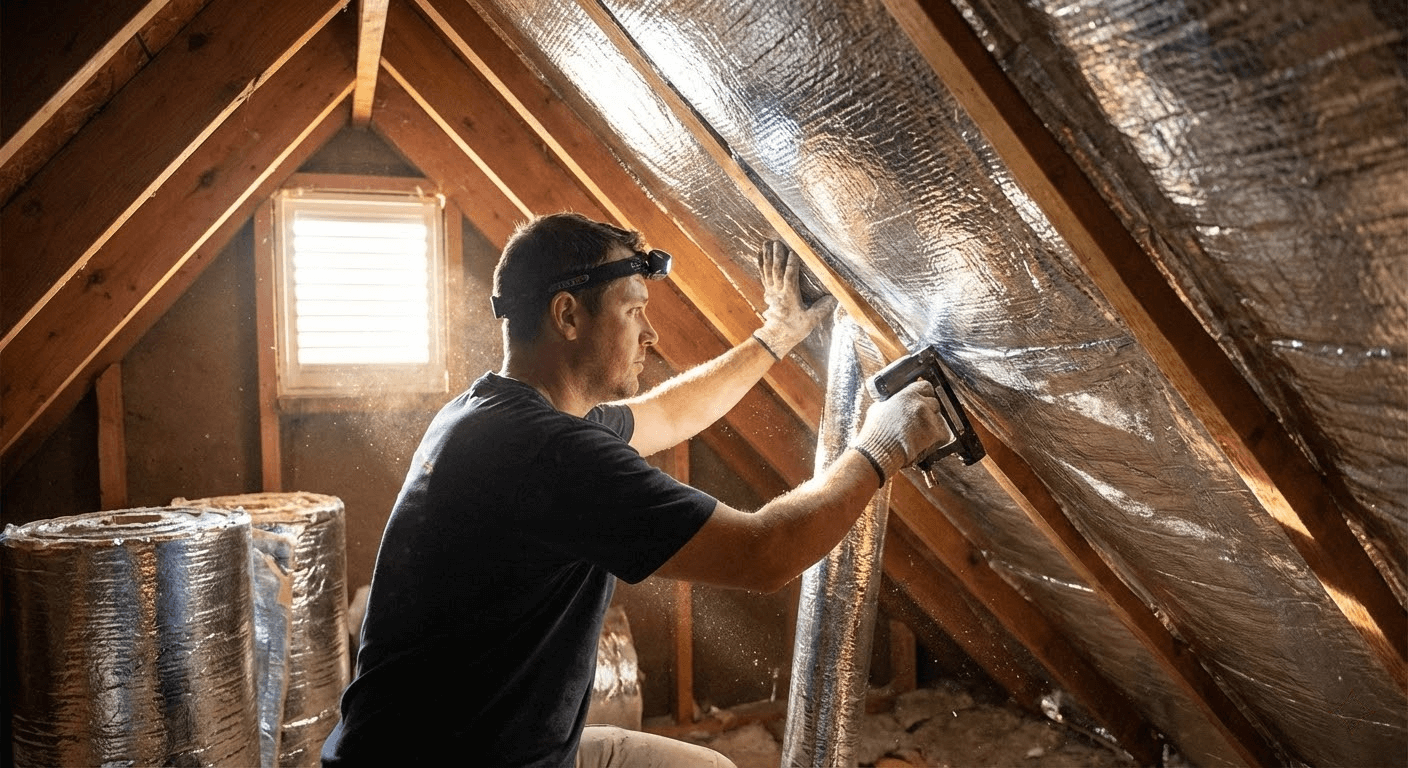
Staple-to-rafters is the most repeatable retrofit method:
-
Maintains a consistent air space
-
Keeps the reflective face less exposed to dust
-
Reduces the chance of crushing foil into insulation
Drape method can be faster in open truss attics, but it’s easier to do poorly (contact points, dust accumulation, airflow interference).
The single most important performance rule: maintain an air space
Radiant barriers need an air space to reflect heat effectively. If the reflective surface is pressed tightly against wood or insulation, performance drops sharply because you’re no longer controlling radiant transfer—you’re creating a conductive path. Manufacturer performance explanations emphasize that reflective technology relies on a low-emittance surface facing an enclosed air space.
Jobsite tip: When I’m checking an install, I look for long “runs” of foil that stay taut and off the insulation, especially near eaves where it’s easiest to accidentally block airflow or create contact.
Seams, overlaps, and fasteners (how to avoid callbacks)
-
Keep runs straight; minimize wrinkles and sag.
-
Overlap seams enough to avoid “daylight gaps.”
-
Use fasteners appropriate for the framing and environment; follow the product’s install sheet for spacing and compatible tapes.
Crew-lead attic checklist (fast, practical)
Before installing:
-
✅ Soffit vents visible and not buried
-
✅ Baffles in place where insulation meets eaves
-
✅ Obvious duct leaks marked for sealing
-
✅ Clearance around heat sources verified (flues, chimneys, older recessed fixtures)
-
✅ Wiring routes identified to avoid stapling hazards
After installing:
-
✅ Ventilation pathways still open (especially at eaves and ridge)
-
✅ Foil stays off insulation and framing contact points are minimized
-
✅ Access paths preserved for service work
Real-World Performance: What Results to Expect
What “good results” typically look like
DOE notes that radiant barriers can reduce cooling costs—often in the 5% to 10% range—when used in warm, sunny climates.
Building America guidance also cautions that some big percentage claims are easily misunderstood: reducing attic heat flow does not automatically translate to the same percentage of whole-home energy savings.
So what’s a practical expectation?
-
Better late-day comfort in rooms under the attic
-
Less AC “struggle time” during peak sun hours
-
A measurable reduction in attic-driven duct losses if ducts are present and not well protected
Anonymized mini case study: “the foil didn’t fix it—until we fixed the attic”
A trade customer retrofitted a 1990s single-story home with long afternoon runtimes. The radiant barrier was planned first, but the pre-check found:
-
blocked soffit intake (insulation packed tight at eaves)
-
leaky duct joints at a main trunk
The crew:
-
restored soffit airflow with baffles,
-
sealed duct joints,
-
leveled insulation coverage,
-
installed staple-to-rafters radiant barrier.
Outcome: occupant reported faster afternoon temperature recovery and steadier hallway temperatures. Crew takeaway: radiant barrier is a multiplier when the attic basics are handled; it’s a disappointment when ventilation and duct leaks are ignored.
Moisture, Ventilation, and Durability Considerations
Moisture: avoid accidental “vapor traps”
In vented attics, maintaining intended airflow is critical. Blocking soffits or creating unintended condensation zones can create moisture problems regardless of what foil you install. If you’re unsure, default to:
-
maintain ventilation pathways,
-
follow product instructions,
-
and use local code guidance for your climate/assembly.
Ventilation and radiant barriers work together
Building-science resources emphasize that attic performance depends on multiple interacting factors (radiant load, ventilation, insulation placement). Radiant barriers can help reduce radiant transfer, but they don’t replace ventilation design and execution.
Durability: plan for the long haul
-
Prefer reinforced products for heavy service traffic.
-
Schedule quick visual checks during HVAC service visits: tears, sagging, and blocked vents are the usual culprits.
Sourcing and Bulk Purchasing Tips for Pros
Estimate like a pro (and avoid running short)
-
Measure attic footprint and roof geometry; include extra for hips/valleys and complex framing.
-
Add accessories to the BOM: baffles, sealants/tapes (as specified), staples, PPE.
-
Standardize one spec across your team so every job matches your expected performance and inspection outcomes.
Storage and SKU consistency matter
Bulk rolls should be stored dry and protected from punctures and crushing. SKU consistency is a quiet but real advantage: fewer install variations means fewer “why did this house feel different?” calls.
Where a factory-direct wholesaler can help
For buyers managing repeat projects, bundling materials reduces procurement friction. Wellco Wholesale positions itself as a professional, factory-direct wholesale supplier with a broad catalog (agricultural, gardening, landscaping, and light building supplies). For trade customers buying in bulk, that “one-stop” approach can simplify ordering radiant barrier rolls alongside related jobsite consumables—without turning every job into a multi-vendor coordination exercise.
Conclusion
A radiant barrier attic foil reflective insulation is most useful when your attic is acting like a radiant heater—hot, sunny exposure, ducts overhead, and comfort issues during peak sun hours. Installed with an air space, intact ventilation paths, and proper safety clearances, it can deliver meaningful comfort improvements and DOE-cited cooling savings in the 5%–10% range for warm, sunny climates.
CTA: If you’re buying for a crew or a property portfolio, spec products by tested low emittance and fire classification, pick a repeatable install method (staple-to-rafters is a strong default), and use a consistent attic checklist so performance is predictable—not dependent on who drew the short straw for the “tight attic” that day.
Frequently Asked Questions
Does radiant barrier attic foil reflective insulation replace attic insulation?
No. It reduces radiant heat transfer, but it doesn’t provide the same resistance to conductive heat flow as fiberglass or cellulose. Most good retrofits prioritize air sealing and adequate R-value insulation first, then add a radiant barrier where it fits.
Will dust ruin a radiant barrier’s performance?
Dust can reduce reflectivity, especially on surfaces that collect debris over time. That’s one reason many installers prefer stapling foil to rafters with the reflective face oriented downward, where it stays cleaner.
Is perforated foil better than non-perforated foil?
In many vented attic retrofits, perforated foil is commonly chosen to reduce moisture concerns. The “right” choice still depends on your attic assembly and local code practices—always follow product instructions.
Can I install it if my attic has HVAC ducts?
Yes—ducts in the attic are one of the scenarios where radiant barriers can be most worthwhile. Pairing the foil with duct sealing (and proper insulation/ventilation) usually produces better comfort and system performance than doing any one step alone.
What’s the biggest installation mistake to avoid?
Letting the foil touch insulation or blocking ventilation paths near the eaves. Radiant barriers need an air space to work effectively, and attic ventilation needs clear pathways to prevent heat and moisture problems.