
7 Best Uses for Reflective Foil Bubble Insulation
Energy loss is one of the most expensive problems facing farmers, contractors, and commercial operators — and most of it happens silently, through poorly insulated roofs, walls, and structures. A poultry barn that overheats in July. A greenhouse that loses heat every night in April. A warehouse where temperature-sensitive stock is constantly at risk. In each case, the fix is often simpler and more affordable than operators expect.
Reflective foil bubble insulation has become one of the most versatile thermal management solutions available to trade buyers. Lightweight, fast to install, and effective across a wide range of climates and building types, it's increasingly the first choice for professionals who need reliable performance without the cost and complexity of traditional insulation systems.
At Wellco Wholesale, a factory-direct supplier of agricultural, gardening, and building supplies, reflective foil bubble insulation is consistently among the highest-demand products for professional and trade customers. Sourcing direct from the factory means buyers get genuine wholesale pricing, consistent stock, and the option to discuss custom roll sizing for large-scale projects — without middleman markups eating into project budgets.
Here are the 7 best uses for reflective foil bubble insulation, along with practical guidance to help you choose and install it correctly.
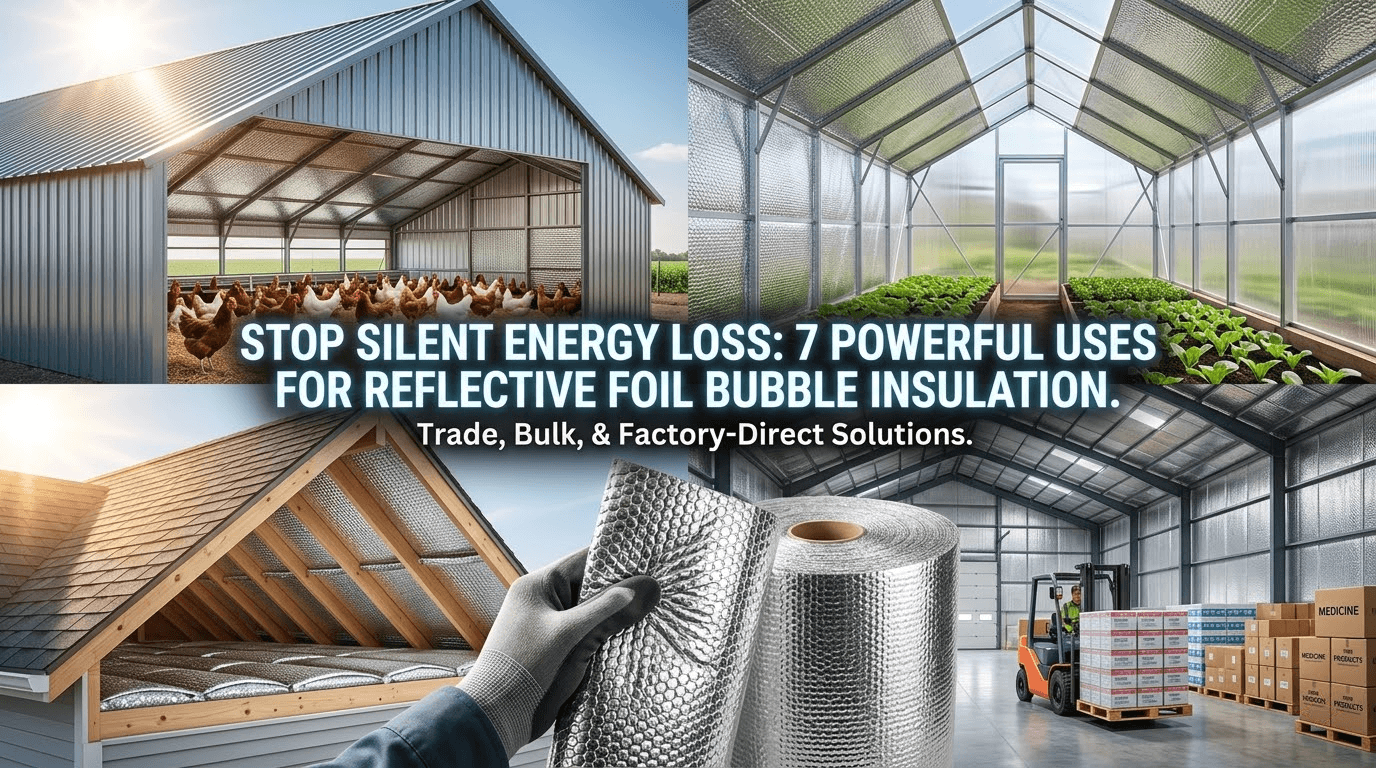
What Is Reflective Foil Bubble Insulation?
Before exploring applications, it's worth understanding exactly what makes this material perform.
How It Works: Reflecting Radiant Heat
Unlike fiberglass batts or rigid foam board — which slow heat transfer by absorption — reflective foil bubble insulation works by reflecting radiant heat away from the surface before it can enter or escape a structure. It consists of one or two layers of metalized polyethylene film bonded to a bubble wrap-style core.
This distinction matters in practice. Radiant heat accounts for up to 93% of heat transfer in many building environments, according to the U.S. Department of Energy. By reflecting that energy rather than trying to absorb it, foil bubble insulation keeps interiors cooler in summer and warmer in winter — often outperforming thicker, heavier traditional materials in hot, sunny climates.
For comparison: fiberglass insulation is better suited to very cold climates requiring high R-values, while spray foam excels at air sealing. Reflective foil bubble insulation occupies a practical middle ground — particularly strong in radiant heat-dominant environments, easy to retrofit, and far more versatile in terms of where and how it can be applied.
Key Components: Foil Layers, Bubble Core & R-Value Explained
The bubble core creates an insulating air gap, while the foil layers handle radiant reflection. R-values for foil bubble products typically range from R-3 to R-21 depending on installation method and — critically — airspace. Maintaining an air gap of at least 19mm on one side of the product is essential to achieving the manufacturer's rated thermal performance. Without it, effective R-value drops significantly.
Buyers sourcing at volume should look for products tested to ASTM C1313, the standard specification for sheet radiant barriers and reflective insulation. This ensures the product's reflectivity and durability claims have been independently verified.
Use #1 & #2: Agricultural Buildings & Livestock Shelters
Keeping Barns and Poultry Houses Temperature-Stable
Corrugated metal roofs — standard on barns, poultry houses, and equipment sheds — conduct heat rapidly, turning interiors into heat traps in summer and cold boxes in winter. Installing reflective foil bubble insulation directly beneath metal roofing dramatically reduces radiant heat gain. Agricultural extension research has shown that reflective radiant barriers can reduce temperatures beneath metal roofing by up to 30°F, directly lowering cooling loads and stabilizing interior conditions.
One large-scale poultry operator managing multiple grow-out houses reported that after lining barn roofs with double-bubble foil insulation, fan runtime during peak summer months dropped noticeably — reducing both energy costs and heat-stress incidents in the flock. Results like this are increasingly common as more agricultural operators make the switch from uninsulated metal structures.
Protecting Livestock from Heat Stress and Cold Snaps
Heat stress in poultry and livestock is a genuine productivity and welfare concern. Laying hens begin to show reduced egg production when ambient temperatures exceed 80°F. Broiler growth rates and feed conversion ratios are similarly affected. Reflective insulation helps maintain safer ambient temperatures without requiring expensive HVAC upgrades — a significant advantage for operators running large facilities on tight margins.
In colder months, the same insulation layer reduces heat loss overnight, helping maintain the minimum temperatures that support animal health and productivity.
Use #3 & #4: Greenhouses & Garden Structures
Extending Growing Seasons with Thermal Efficiency
For growers, every additional productive week has real dollar value. Lining the interior walls and roof of a greenhouse with reflective foil bubble insulation creates a thermal envelope that retains nighttime heat while deflecting excessive daytime solar gain — a dual action that makes it well-suited to shoulder-season growing in temperate climates.
The material's flexibility means it can be cut and fitted to curved or irregularly shaped greenhouse frames without waste or specialist tools, making it practical for both small hobby growers and large commercial horticultural operations.
Protecting Seedlings and Cold-Sensitive Plants
Seedling propagation areas and overwintering spaces benefit enormously from the added thermal stability. A single layer of foil bubble insulation can prevent the sharp overnight temperature drops that damage or kill young plants, reducing losses and improving germination rates. For growers purchasing at scale, the cost per square metre is low enough that lining an entire propagation area represents a modest investment relative to the crop value it protects.
Use #5: Residential Roof and Attic Insulation
Radiant Barrier Performance in Hot Climates
In hot, sunny climates, attic temperatures can exceed 150°F on summer afternoons. This heat radiates downward through ceilings and forces air conditioning systems to work significantly harder. The Oak Ridge National Laboratory has found that installing a reflective radiant barrier in the attic can reduce residential cooling costs by 5–10% annually — meaningful savings over the product's lifetime.
Installation Tips — and Mistakes to Avoid
Foil bubble insulation cuts with standard scissors or a utility knife and staples directly to rafters or joists. It requires no protective gear, unlike fiberglass, making it faster and more comfortable to install — a genuine labor cost advantage for contractors managing multiple jobs.
That said, a few common installation errors can undermine performance:
- Skipping the air gap. The foil needs open air space on at least one side to reflect effectively. Sandwiching it tightly between two solid surfaces eliminates most of its thermal benefit.
- Unsealed seams. Gaps at overlaps and edges allow heat to bypass the barrier. Use foil tape — not standard duct tape — to seal all joins properly.
- Ignoring condensation risk. In humid environments, moisture can accumulate between the foil and an adjacent surface. Ensure adequate ventilation or use a product with a perforated foil facing that allows vapor to escape.
Use #6 & #7: Commercial & Industrial Applications
Warehouses, Storage Units and Cold Chain Facilities
Temperature-sensitive goods — food products, pharmaceuticals, electronics — require stable storage environments. Lining warehouse walls and roofs with reflective foil bubble insulation provides a practical and cost-effective thermal upgrade compared to full mechanical climate control. It's particularly valuable in facilities where refrigeration isn't viable but temperature fluctuation still needs to be managed within acceptable limits.
For large-scale installations, Wellco Wholesale's factory-direct supply model allows trade buyers to specify roll dimensions that minimize cutting waste and reduce installation time — a practical advantage when insulating thousands of square metres of floor space.
Shipping Containers and Mobile/Temporary Structures
Repurposed shipping containers are increasingly used as on-site offices, pop-up retail spaces, and temporary cold storage. Metal walls and roofs make them notoriously uncomfortable across seasons. A layer of reflective foil bubble insulation applied to interior surfaces transforms thermal comfort quickly and at low cost — without adding significant weight or requiring structural modification.
How to Choose the Right Product for Your Project
Single vs. Double Bubble: Which Do You Need?
- Single bubble — lighter and more flexible; ideal for pipe wrap, underfloor applications, and lining smaller or irregularly shaped structures.
- Double bubble — adds an extra insulating air layer; better suited to roofing, barn walls, warehouse ceilings, and greenhouse linings where maximum thermal resistance is needed.
Limitations & When to Consider Alternatives
Reflective foil bubble insulation performs best in radiant heat-dominant environments. It has real limitations that buyers should understand before specifying it:
- Very cold climates — In regions with extreme winter temperatures, foil bubble insulation alone may not achieve the R-values required by local building codes. It performs best as part of a layered insulation strategy alongside higher R-value materials.
- Fire-rated applications — Standard foil bubble products are not fire-rated. Where building codes require fire-resistant insulation — in commercial construction or certain agricultural facilities — check product certifications carefully and consult local regulations.
- Permanent residential wall cavities — For standard stud-wall construction in temperate climates, traditional insulation typically offers better cost-per-R-value performance. Foil bubble insulation shines in retrofit, roof, and open-structure applications.
Buying in Bulk: What Trade Customers Should Look For
Beyond price, professional buyers sourcing at volume should evaluate:
- Roll width and length — wider rolls mean fewer seams and faster installation
- Foil purity and reflectivity rating — higher-grade metalized film maintains performance over time
- Puncture and tear resistance — critical in agricultural settings where the material faces physical handling
- ASTM C1313 compliance — confirms independent testing of reflectivity and thermal performance claims
- Supplier reliability — consistent stock availability and lead times matter on large or time-sensitive projects
Wellco Wholesale supplies reflective foil bubble insulation direct from the factory, giving professional and trade buyers access to competitive wholesale pricing across single and double bubble formats. As a one-stop wholesale source spanning agricultural, gardening, landscaping, and light building supplies, it simplifies procurement for operators managing diverse project requirements.
Conclusion
Reflective foil bubble insulation earns its reputation as one of the most adaptable thermal solutions available to trade buyers and commercial operators. From livestock barns and greenhouses to residential attics, warehouses, and shipping containers, its combination of lightweight construction, straightforward installation, and genuine radiant heat performance makes it a practical choice across a wide range of real-world applications.
Used in the right context — and installed correctly — it delivers consistent results at a price point that works for professional volumes. Understanding its limitations is just as important as understanding its strengths: pair it with complementary materials where building codes or climate demands require higher R-values, and always source from a supplier who can verify product standards.
For those purchasing at scale, Wellco Wholesale offers factory-direct access to quality reflective foil bubble insulation with the pricing, stock reliability, and product range that trade customers need. Explore bulk insulation options and the full agricultural and building supplies catalog at Wellco Wholesale.
Frequently Asked Questions
What is the R-value of reflective foil bubble insulation? R-values typically range from R-3 to R-21 depending on the product type and installation method. Achieving the higher end of that range requires maintaining a clear air gap of at least 19mm on one side of the insulation. Always check the manufacturer's tested R-value for your specific installation configuration.
Can reflective foil bubble insulation be used as the sole insulation in very cold climates? In regions with extreme winter temperatures, foil bubble insulation alone is generally not sufficient to meet building code R-value requirements. It performs best as part of a layered approach — combined with higher R-value materials like rigid foam or fiberglass batts — or in applications where radiant heat control is the primary concern rather than total thermal resistance.
How do I seal the seams when installing foil bubble insulation? Always use purpose-made foil tape rather than standard duct tape. Foil tape maintains its bond over temperature fluctuations and provides a reflective, airtight seal at overlaps and edges. Properly sealed seams are critical to preventing heat from bypassing the barrier and compromising overall performance.
What should I look for when buying reflective foil bubble insulation in bulk? Look for products tested to ASTM C1313, which independently verifies reflectivity and thermal performance. Evaluate roll dimensions for installation efficiency, check foil grade and puncture resistance for your specific application, and confirm your supplier can maintain consistent stock levels for large or ongoing projects.
Is reflective foil bubble insulation safe to handle and install? Yes — unlike fiberglass insulation, foil bubble products do not release airborne particles and require no specialist protective equipment during handling or installation. They can be cut with standard tools and are safe to work with in enclosed spaces, making them a practical choice for both professional installers and experienced DIYers.