
Acoustic Panels vs Foam: Which Reduces Noise Better?
You install acoustic foam, close the door, and still hear traffic or conversations through the wall. This happens because acoustic treatment and soundproofing address different problems. Panels and foam reduce reflections inside a room. Structural soundproofing depends on mass, sealed gaps, isolation, and vibration control.
This guide compares acoustic panels and foam by absorption range, durability, installation, and cost. It also helps you identify the noise problem before buying treatment.
What Do Acoustic Panels and Acoustic Foam Actually Do?
Before comparing products, identify what each material controls. Depth, internal structure, placement, and mounting all affect useful performance.
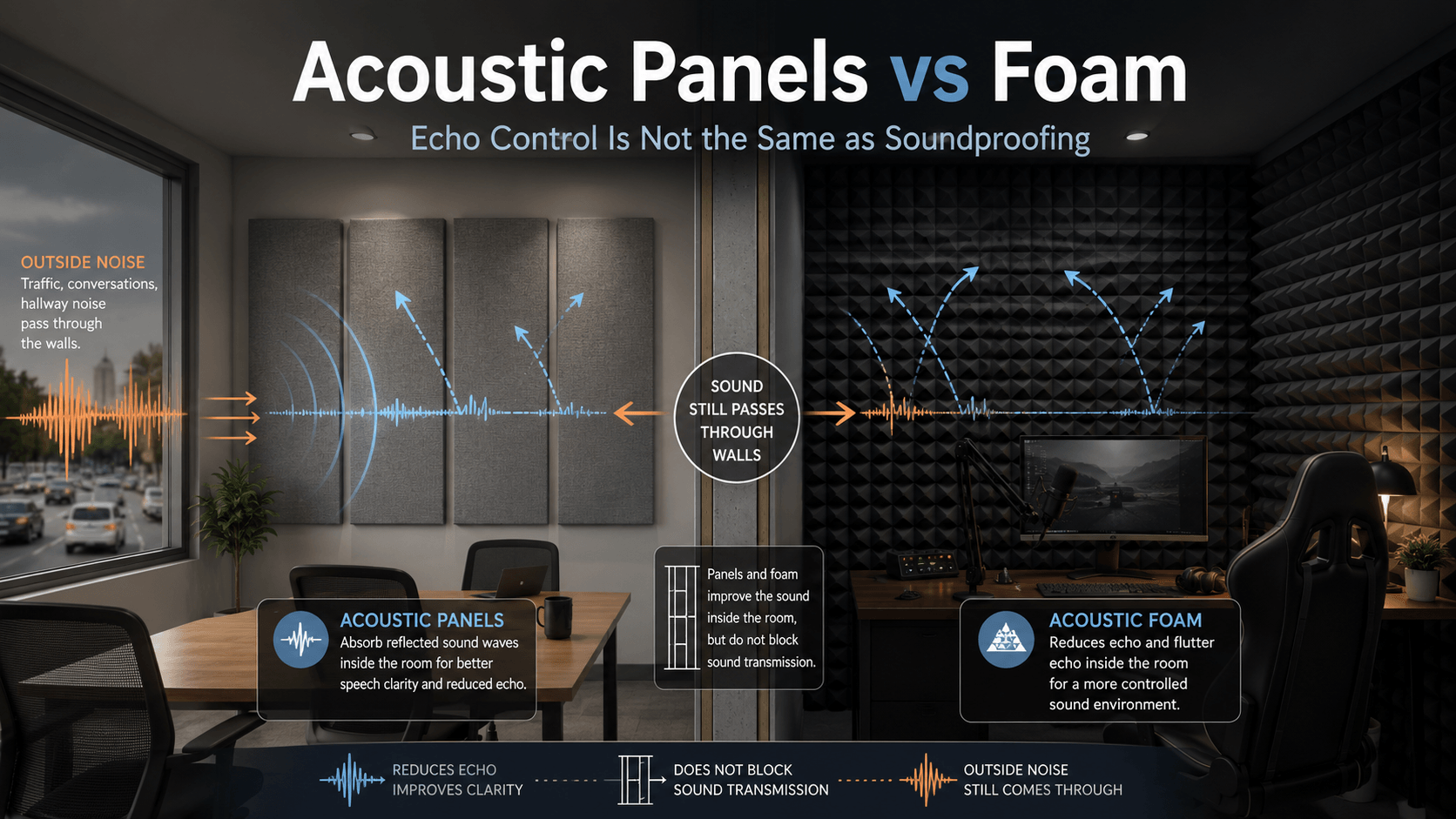
How Acoustic Panels Absorb Reflected Sound
Fabric wrapped fiberglass, mineral wool, and polyester panels absorb sound as air moves through their porous structure. This reduces reflections from hard walls and ceilings.
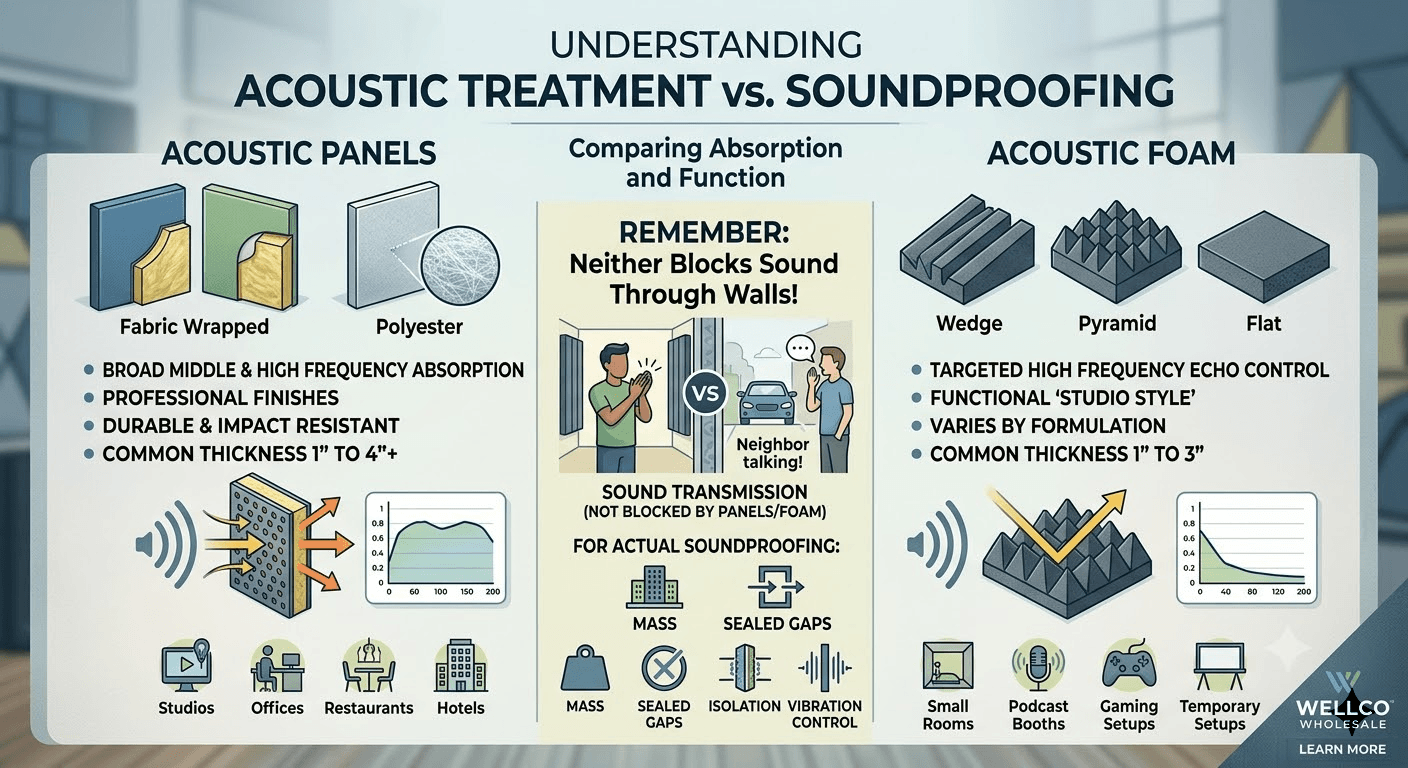
A 1 inch panel usually focuses on higher frequencies. A 2 inch panel provides broader speech and music control, while a 4 inch panel or an air gap may improve lower midrange absorption. Density alone does not determine performance.
How Acoustic Foam Controls Echo
Open cell foam comes in wedge, pyramid, and flat profiles. Its shaped surface increases exposed area, although shape alone does not guarantee low frequency absorption.
Thin foam can reduce flutter echo near a microphone, desk, or gaming setup. Its limited depth usually makes it less effective against bass buildup and room modes.
Do Acoustic Panels or Foam Block Sound Through Walls?
Neither acoustic panels nor foam provides meaningful wall soundproofing when mounted alone. They reduce reflections inside a room, while transmission through walls depends more heavily on mass, sealed gaps, structural isolation, and vibration paths. Effective upgrades may include acoustic sealant, additional drywall, isolation clips, resilient channels, or improved doors and windows.
A calmer sounding room may still leak voices through its walls, so diagnosis matters.
Acoustic Panels vs Foam: Which Reduces Noise Better?
Once you separate echo from transmission, compare how broadly each product controls reflected sound. Tested frequency performance matters more than appearance.
Comparing Absorption, Frequency Range, and Durability
This table summarizes the main differences:
| Factor | Fabric Wrapped Panels | Polyester Panels | Acoustic Foam |
|---|---|---|---|
| Main strength | Broad middle and high frequency absorption | Balanced absorption and decorative flexibility | Targeted high frequency echo control |
| Common thickness | 1 to 4 inches | About 0.35 to 2 inches or more | 1 to 3 inches |
| Lower frequency potential | Better with greater depth or an air gap | Moderate when sufficiently thick | Usually limited when thin |
| Durability | Strong with quality fabric and framing | Impact resistant and resistant to fiber shedding | Varies by formulation and environment |
| Appearance | Professional fabric finishes | Clean colors and cut shapes | Functional studio style |
| Best fit | Studios, offices, restaurants | Offices, schools, hotels, homes | Small rooms and temporary setups |
NRC compresses several measurements into one rating, so similar scores can hide different results at 125, 250, 500, 1,000, 2,000, and 4,000 Hz. Ask for frequency specific coefficients and confirm the mounting used during ASTM C423 or ISO 354 testing.
Which Material Handles Speech, Music, and Bass Most Effectively?
Foam can control speech range and high frequency reflections near microphones or listening positions. Music rooms often need wider control.
A tested 2 inch or 4 inch broadband panel may cover a wider range than thin foam. Corner bass traps add depth for lower frequency room modes. Choose according to the target frequencies.
Panels usually offer broader treatment. Foam remains practical for localized echo control.
Where Should You Use Panels or Foam?
Room use, surface finishes, and the noise source should guide the treatment plan.
Application Suitability by Room Type
The table below provides a practical starting point:
| Room or Use Case | Recommended Treatment | Main Reason |
|---|---|---|
| Home office | Polyester or fabric wrapped panels | Improves call clarity |
| Recording room | Broadband panels plus bass traps | Controls a wider frequency range |
| Podcast booth | Panels with limited targeted foam | Reduces vocal reflections |
| Restaurant | Durable wall or with limited targeted foam | Reduces vocal reflections |
| Restaurant | Durable wall or ceiling panels | Reduces reverberation across a large area |
| Gaming room | Decorative panels or thicker foam | Controls echo without construction |
| Traffic affected bedroom | Soundproofing plus absorption | Treats transmission and reflections separately |
Consider a 12 by 15 foot office with glass partitions, hard flooring, and long call echo. Treating first reflection points and adding a ceiling cloud can improve speech clarity. Foam beside the door would do little for hallway voices entering around the frame.
When Foam Is a Practical Choice
Foam suits projects where low weight, easy cutting, modest cost, and temporary installation matter. Its lifespan varies with formulation, sunlight, humidity, handling, and adhesive choice. For public spaces, request product specific fire documentation.
When Acoustic Panels Provide Better Long Term Value
Panels often fit offices, hotels, restaurants, schools, and studios because they offer broader treatment, cleaner edges, larger formats, and more durable finishes.
Wellco Wholesale buyers can ask about samples, specifications, custom dimensions, quantities, and test documents. Documentation varies by construction, so review the exact item before approval.
Choosing by application and verified data improves long term value.
How Do You Choose the Right Product for Your Room?
After narrowing the material category, diagnose the room and define the result you need.
Identify Whether the Problem Is Echo or Sound Transmission
Clap once and listen. Ringing, flutter, or muddy speech suggests excessive reflection. Clear voices or traffic passing through a closed wall, door, or window indicates airborne transmission.
Inspect door seals, glazing, outlets, vents, and wall penetrations. Vibration from speakers or machinery may require isolation or damping.
How Thick Should Acoustic Treatment Be?
A 1 inch product usually targets higher frequency reflections, while a 2 inch panel provides broader speech and music control. A 4 inch panel or a panel mounted with an air gap may improve lower frequency absorption. Final performance still depends on construction, density, mounting, room size, and tested frequency data.
Video calls may need thinner treatment, while music rooms often benefit from broadband absorbers and corner traps.
Calculate Coverage Without Treating Every Surface
Start with first reflection points, the wall behind or opposite the listening position, and ceiling areas above desks or recording zones.
Note reflective surfaces and existing soft furnishings. Treat a small area first, assess the result, and expand where needed.
Compare Total Project Cost
Include product price, hardware, freight, labor, replacement, and future reconfiguration. Foam may work well in a dry, low traffic room but offer weaker value where sunlight or handling shortens its life. For larger orders, evaluate a sample of the planned construction.
A small trial can save more than choosing the lowest unit price.
Installation Methods That Affect Performance
Placement and mounting change effective depth and reflected sound paths.
Wall Mounting, Air Gaps, and Placement
Adhesive mounting keeps treatment close to the wall. Clips, Z clips, stand off brackets, and freestanding frames support removal or an air gap, which can improve lower frequency performance.
Ceiling Clouds and Corner Treatment
Ceiling clouds help where wall area is limited or reflections occur between a hard floor and ceiling. Corners often hold strong low frequency pressure, so thick corner absorbers provide more useful depth than thin wall foam.
Fire Safety, Indoor Air Quality, and Documentation
Request fire test reports, material composition, emissions information, and installation instructions for the exact product. Code acceptance depends on the substrate, mounting, room type, and local authority. A useful report identifies the material, method, result, and represented conditions.
Good installation protects acoustic performance and project compliance.
Common Buying Mistakes to Avoid
Many failed projects begin with the wrong diagnosis or incomplete product data.
Treating Acoustic Foam as Complete Soundproofing
Some listings use “soundproofing” broadly. Inspect walls, doors, windows, seals, ceiling paths, and vibration sources. Absorption reduces reverberation but cannot replace the mass, sealing, and isolation needed for substantial transmission control.
Choosing by Shape or Color Alone
Wedges and pyramids look technical, while thickness, airflow resistance, complete construction, mounting, and tested absorption have greater practical value. Ask for frequency specific data whenever available.
Ignoring Room Measurements and Installation Constraints
Measure walls, ceilings, outlets, HVAC openings, sprinklers, and doors. Consider humidity, cleaning, adhesive compatibility, and future removal. For cut to fit work, allow 5 to 10 percent for trimming, damage, and replacement.
Careful measurement turns a product comparison into a workable installation plan.
Conclusion
Acoustic panels usually provide broader and more durable room absorption. Foam offers a lightweight, affordable option for targeted high frequency echo control. Neither product alone stops substantial transmission through a wall.
Keep these four priorities in mind:
-
Identify whether the problem involves echo, transmission, or vibration.
-
Compare frequency specific data under similar test conditions.
-
Match thickness, mounting, and placement to the target frequencies.
-
Test a sample or small area before placing a large order.
Wellco Wholesale can support small purchases and larger acoustic material orders, with available samples, specifications, custom dimensions, and documentation depending on the selected product.
[Shop Wellco Wholesale’s ace with flexible ordering and free shipping over $300 →]