
Acoustic Panels vs Foam: Absorption Effectiveness
A room can sound harsh even when it looks finished. Glass, drywall, concrete, and bare ceilings reflect speech and music, creating flutter echo, blurred dialogue, and listening fatigue. When comparing acoustic panels vs foam soundproofing absorption effectiveness, first identify whether you need better sound inside the room or less sound passing through the building.
This guide compares frequency performance, thickness, mounting, durability, documentation, and room suitability. The recommendations draw on ASTM C423-23e1 and ISO 354:2003 for sound absorption, ISO 10140-2:2021 for airborne sound insulation, and published porous-absorber research. ASTM C423 measures absorption through reverberation-room decay rates, while ISO 354 provides a reverberation-room method for wall, ceiling, and space absorbers.
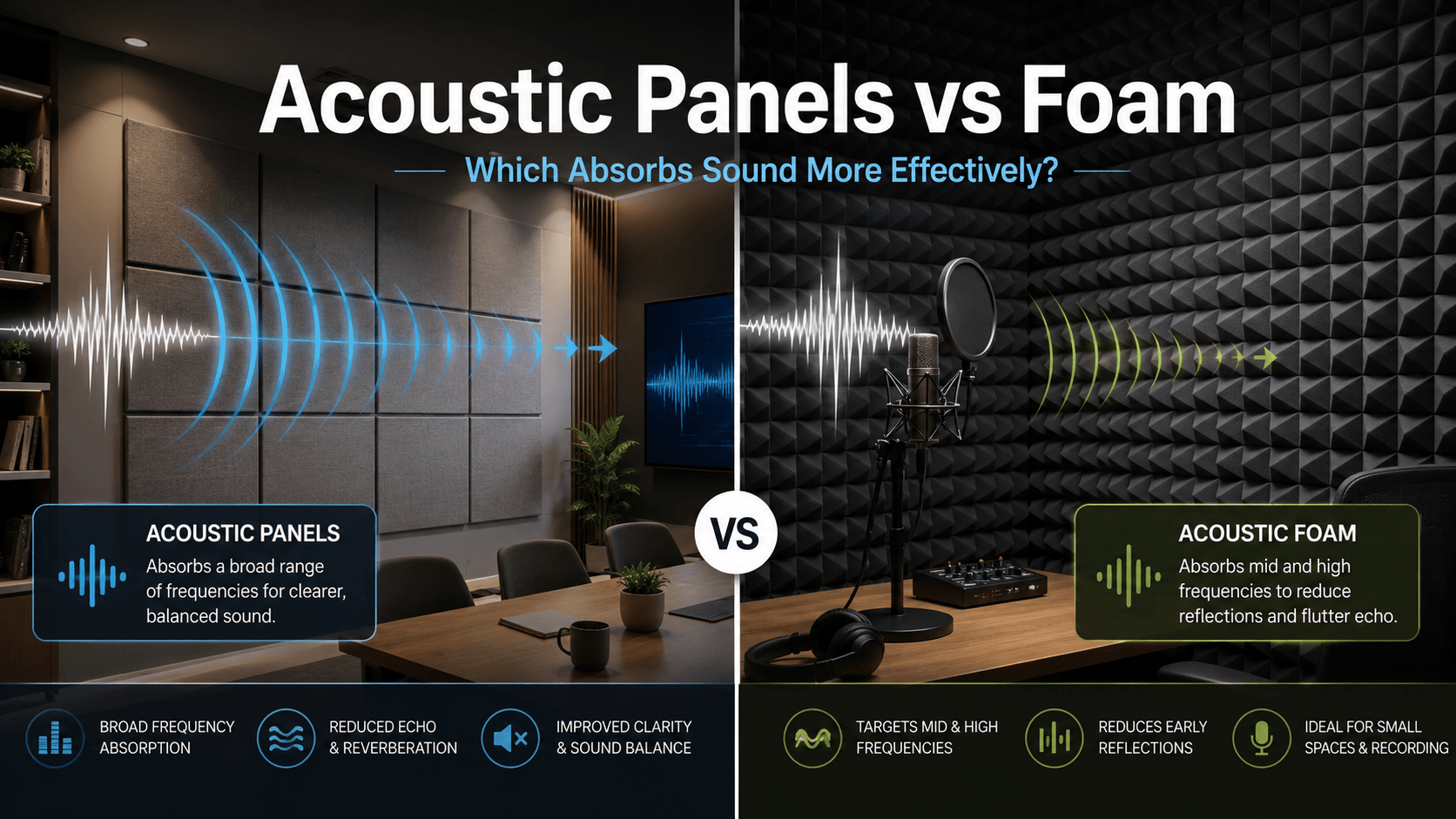
Acoustic Panels vs Foam: What Is the Main Difference?
Acoustic panels usually contain fiberglass, mineral wool, or polyester fiber behind an acoustically transparent fabric. Their porous cores resist air movement as sound passes through, reducing reflected energy across speech and music frequencies.
Acoustic foam commonly uses open-cell polyurethane or melamine foam in flat, wedge, pyramid, or egg-crate profiles. Surface shaping increases exposed area, but the shallowest part of the foam still limits low-frequency performance.
The table below separates the problems each treatment can realistically address:
| Treatment Goal | Acoustic Panels | Acoustic Foam | Main Decision Factor |
|---|---|---|---|
| Reduce speech echo | Usually well suited | Often suitable | Coverage and placement |
| Improve recording clarity | Common broadband choice | Useful for targeted reflections | Thickness and test data |
| Control bass buildup | Requires thick panels or bass traps | Thin foam is usually limited | Low-frequency design |
| Block outside noise | Minimal effect alone | Minimal effect alone | Building assembly |
| Match interior design | Many fabric options | Distinct studio appearance | Finish and durability |
Thin foam may calm sharp reflections in a podcast booth. A larger meeting room with glass walls usually needs broader wall and ceiling coverage using tested panels.
Product type matters, while thickness, placement, and verified test performance determine the result.
Which Material Absorbs Sound More Effectively?
Price and appearance are easy to compare. Acoustic performance requires more care because a single rating can hide major differences by frequency.
Understanding NRC and Absorption Coefficients
Under ASTM C423, the Noise Reduction Coefficient is a rounded single-number average based on absorption coefficients at 250, 500, 1,000, and 2,000 Hz. It helps screen products, but it does not show performance at 125 Hz, 4,000 Hz, or individual test bands. Ask for the complete report, including specimen thickness and mounting.
Acoustic Panels vs Foam by Frequency Range
The following comparison describes common tendencies, not guaranteed ratings:
| Frequency Range | Typical Panel Tendency | Typical Foam Tendency | Buyer Check |
|---|---|---|---|
| Low | Improves with thickness and spacing | Often limited when thin | Review 125 and 250 Hz data |
| Mid | Usually strong with adequate depth | Can be effective | Compare matching thicknesses |
| High | Usually strong | Often strong | Avoid treating only highs |
| Broadband | Common panel strength | Highly thickness dependent | Check every frequency band |
Are Acoustic Panels More Effective Than Foam?
Acoustic panels are generally more effective for broadband absorption because commercial panels are often thicker and use fibrous cores that manage a wider frequency range. Foam can control mid- and high-frequency reflections effectively, but thin tiles usually contribute little at bass frequencies. Results depend on measured coefficients, coverage, mounting, and room geometry.
A home theater may benefit from panels at first-reflection points and a ceiling cloud. A small voice booth may use foam successfully when low-frequency accuracy is less critical.
Choose the tested absorption curve that matches the room’s problem.
How Thickness, Density, and Air Gaps Affect Results
Once you understand the ratings, examine the physical construction. Decorative shapes attract attention, while depth and airflow resistance usually have a larger effect on useful bandwidth.
Why Thickness Matters More Than Surface Shape
Thicker porous material gives sound more depth in which to dissipate energy. A study of rebonded polyurethane foam found that increasing thickness improved low- to mid-frequency absorption and moved the first absorption peak downward. A 20 mm sample exceeded an absorption coefficient of 0.8 only above 2,630 Hz at the highest tested density. This result illustrates one material system and does not apply universally.
For wedge foam, compare minimum, average, and maximum thickness. A product advertised as two inches at the peak may contain much less material across most of its surface.
Does Higher Density Always Improve Absorption?
Higher density can increase airflow resistance, but maximum density does not automatically produce maximum absorption. Porosity, cell structure, thickness, and mounting also influence performance. The same study tested densities from 40 to 80 kg/m³ and found results changed with both thickness and frequency.
Does an Air Gap Improve Acoustic Panel Performance?
An air gap can extend useful absorption toward lower frequencies. In the cited study, a 50 mm gap behind a 70 mm foam sample shifted absorption peaks lower; at 500 Hz, the coefficient increased by 21% to 66% depending on density. Higher-frequency performance did not improve uniformly.
For many wall panels, a gap close to the panel thickness is a practical starting point when mounting safety and space allow it.
Acoustic Panels vs Foam for Different Rooms
Selection becomes easier when you match treatment to the room’s dominant sound and operating requirements.
| Room | Practical Starting Choice | Additional Check |
|---|---|---|
| Podcast or home studio | Wall panels and ceiling treatment | Add bass traps if needed |
| Office or classroom | Durable, tested panels | Verify fire and cleaning requirements |
| Home theater | Panels at reflection points | Preserve some reflective surfaces |
| Restaurant or hotel | Wall panels or ceiling clouds | Plan access and maintenance |
| Small vocal booth | Foam or compact panels | Treat more than one surface |
In a studio, covering only the wall behind the microphone leaves sidewall and ceiling reflections active. Treating early-reflection paths usually works better than concentrating all material in one patch.
For a restaurant with glass walls, hard flooring, and an exposed ceiling, purchasing should address panel area, suspension hardware, cleanability, fire documentation, lead time, and replacement matching. Wellco Wholesale supports one-piece minimum ordering, bulk discounts, a 90,000-square-foot California warehouse, blind drop shipping, and OEM or ODM services.
Room use determines the finish and installation method as much as material choice.
What Acoustic Foam and Panels Cannot Do
Even a high-absorption product disappoints when the real problem is transmission from neighbors, traffic, machinery, or another floor.
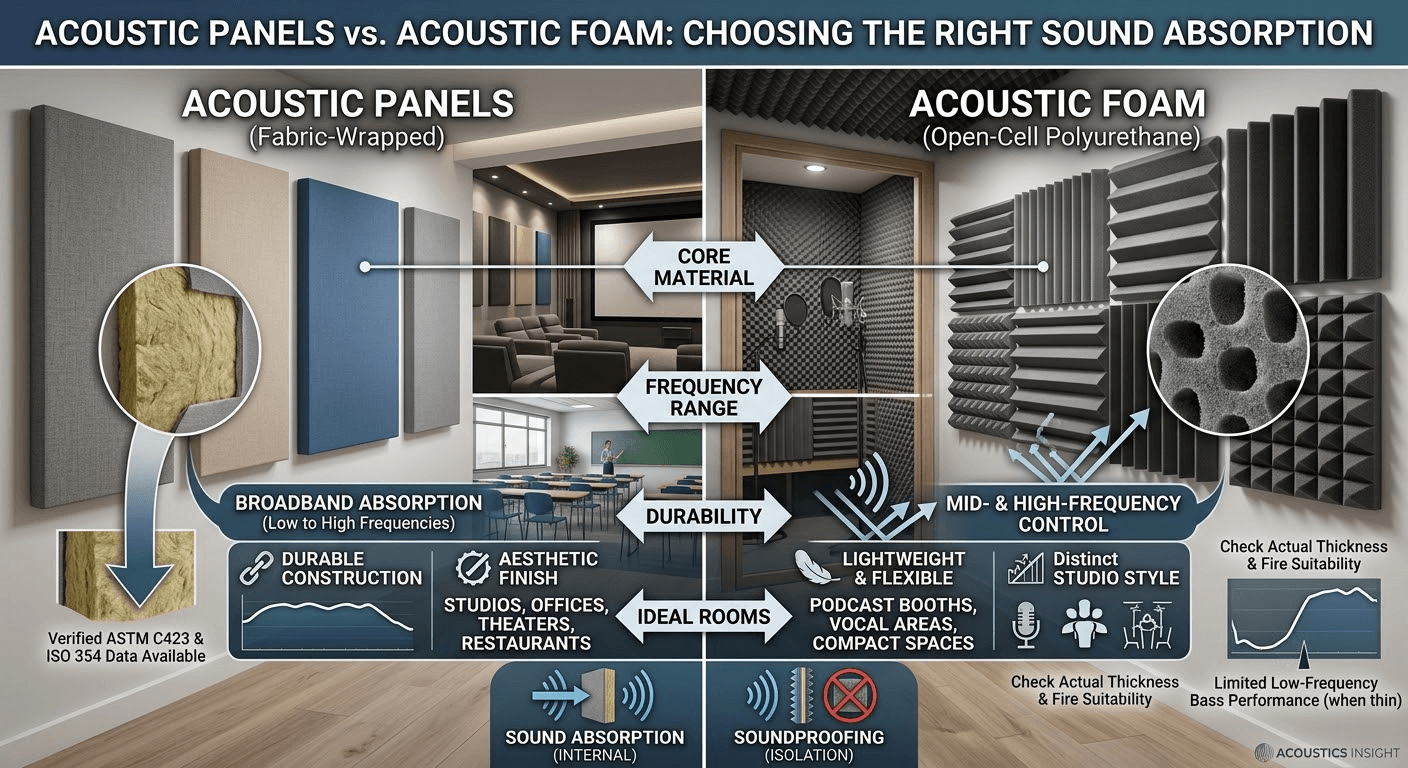
Sound Absorption Is Different From Soundproofing
Absorption reduces reflections within a room. Sound isolation reduces energy transmitted through walls, floors, ceilings, doors, windows, and penetrations. ISO 10140-2:2021 covers laboratory measurement of airborne sound insulation for building elements and notes that field performance can differ because of flanking paths and boundary conditions.
Will Acoustic Foam Stop Noise From Neighbors?
Acoustic foam will not significantly stop neighbor noise through a shared wall because it adds little mass and does not seal leakage paths. It may reduce echo inside your room. Transmission control usually requires sealed gaps, improved doors, added mass, damping, or mechanically separated construction.
Identify airborne noise, impact vibration, or flanking transmission first. A television heard through a lightweight partition needs a different solution from footsteps transmitted through a floor.
Consult an acoustical professional when noise affects sleep, compliance, or a major renovation budget.
How to Compare Products Before Buying
With the application defined, compare quotations using documents that verify equivalent products.
| Factor | What to Request | Why It Matters |
|---|---|---|
| Acoustic performance | Full ASTM C423 or ISO 354 report | Shows frequency-specific absorption |
| Test configuration | Thickness, facing, area, and mounting | Prevents misleading comparisons |
| Fire performance | Report for the complete assembly | Covers core, fabric, and adhesive |
| Emissions | Applicable indoor-air documentation | Supports occupied spaces |
| Durability | Cleaning, moisture, UV, and impact guidance | Affects service life |
| Commercial terms | MOQ, lead time, packaging, customization | Supports project planning |
ISO 354 results support product comparison and room-acoustics design, while ASTM C423 covers reverberation-room measurement of absorptive specimens and objects. Compare reports produced under matching configurations.
A low unit price can become expensive when a project needs extra coverage, replacements, or reinstallation.
How to Choose Between Acoustic Panels and Foam
Choose acoustic panels for broader frequency control, large-area treatment, decorative finishes, or commercial documentation. They commonly suit studios, offices, classrooms, theaters, restaurants, and hospitality interiors.
Choose acoustic foam for lightweight, easy-to-cut treatment in compact recording areas, equipment spaces, hobby rooms, or targeted mid- and high-frequency control. Check actual thickness and fire suitability before ordering.
Use both when each material has a defined role. A balanced room might combine wall panels, a ceiling cloud, corner bass traps, and small foam sections inside a vocal booth.
Four decisions prevent most purchasing mistakes: identify absorption versus isolation, compare full frequency data, account for mounting and air gaps, and verify safety and durability documents.