
Radiant Barrier Bubble Aluminum Foil Reflective Insulation Benefits
Sun heated roofs, garage doors, and vehicle panels can radiate heat indoors. Radiant barrier bubble aluminum foil reflective insulation can reduce that transfer when its foil face borders a properly designed air space.
This guide explains its benefits, limitations, applications, installation requirements, and buying criteria, including when to pair it with bulk insulation.
How Radiant Barrier Bubble Insulation Works
Reflective insulation controls a different heat transfer path from thick insulation.
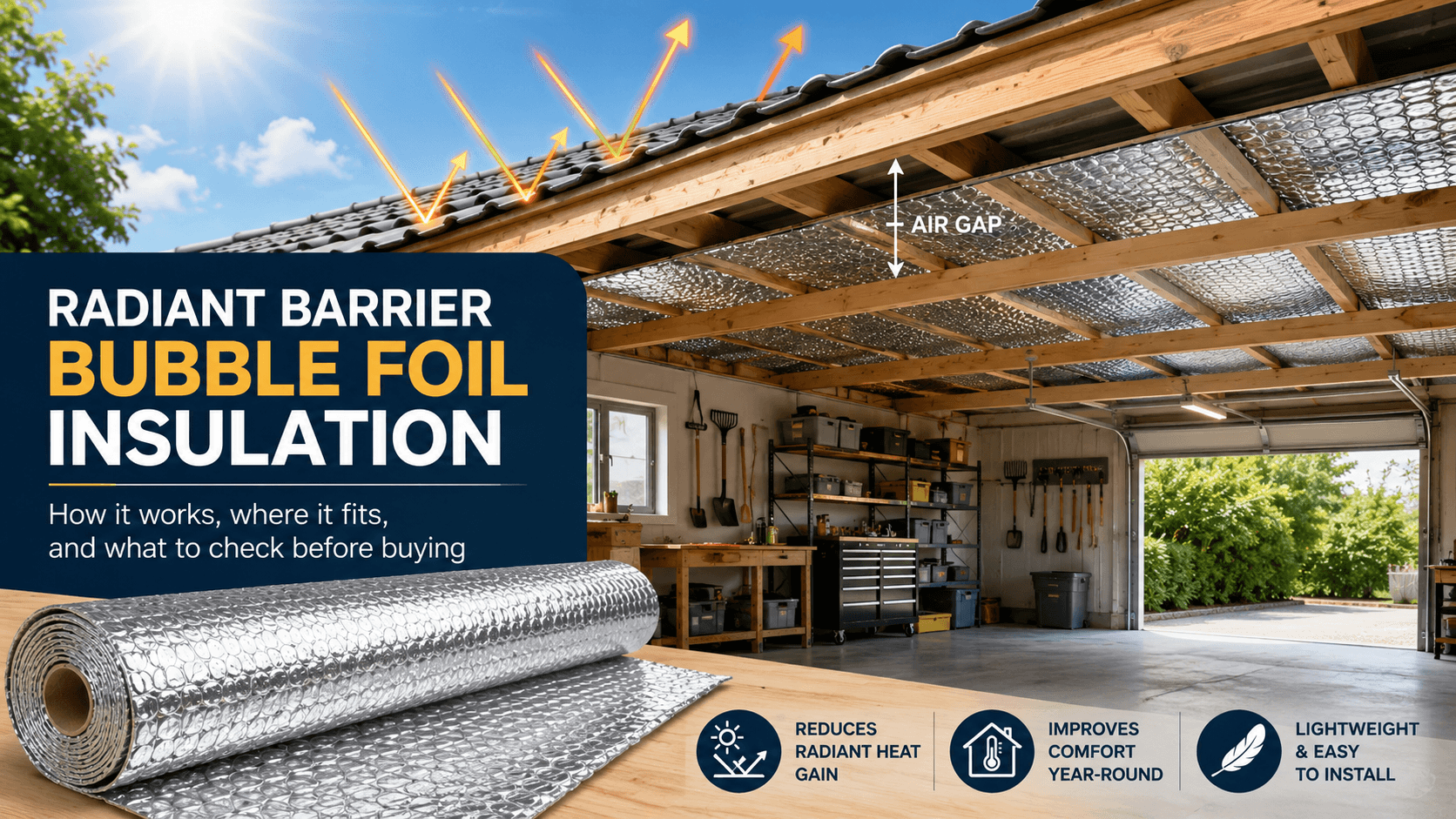
Reflective Foil and Radiant Heat Transfer
Low emittance aluminum releases less radiant energy across an adjacent cavity. ASTM C1224 defines reflective insulation around low emittance surfaces facing enclosed air spaces and uses an emittance of 0.1 or less as a key performance condition.
Products may advertise 95% to 97% reflectivity, but you should verify each claim through product specific testing. ASTM C1371 provides a recognized method for measuring surface emittance near room temperature.
Why the Bubble Layer Matters
The bubble core supports the foil and creates a flexible roll for framing, doors, ducts, and vehicle cavities. Its thin profile cannot match several inches of fiberglass or rigid foam.
Does Reflective Bubble Insulation Need an Air Gap?
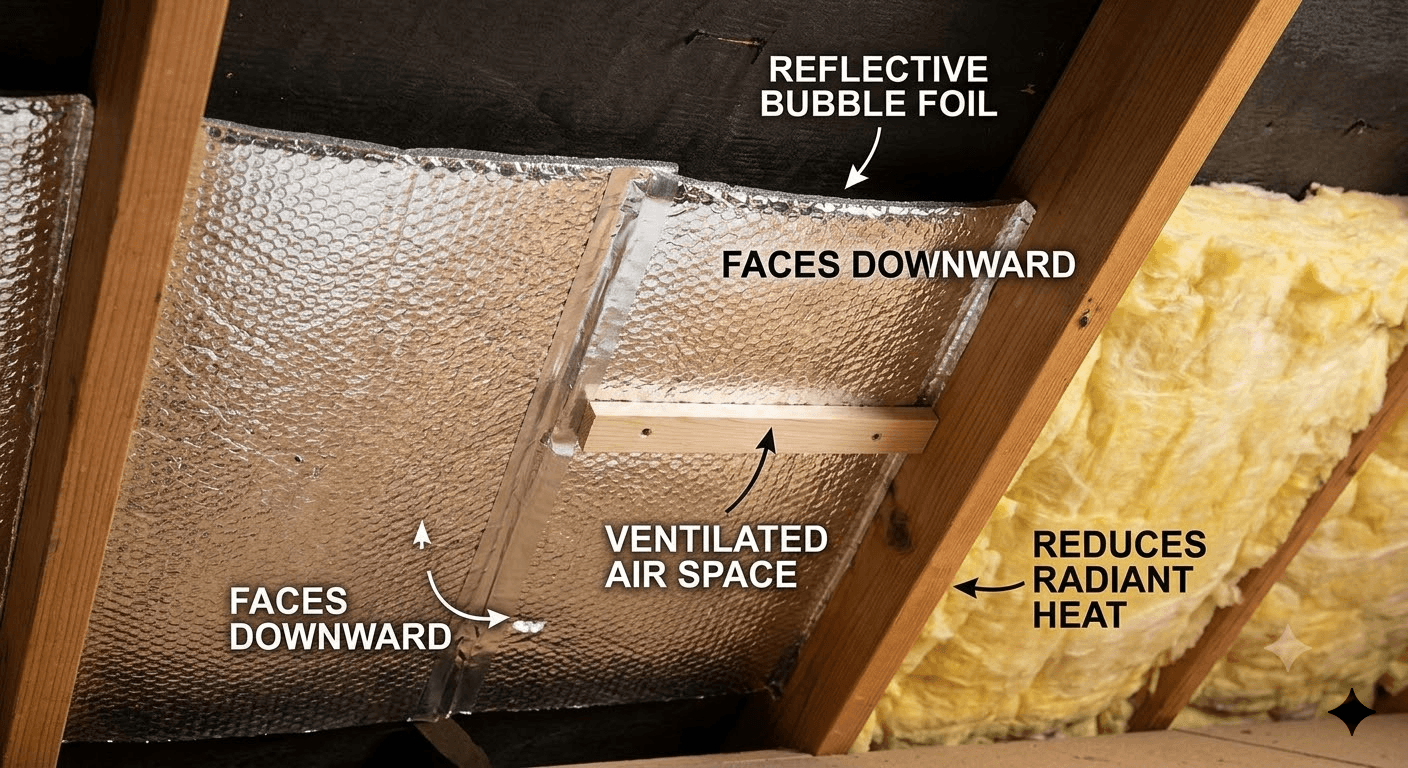
Yes. Reflective insulation needs at least one foil surface facing an air space to control radiant heat effectively. When compressed between solid layers, heat moves mainly by conduction and the reflective benefit falls sharply. Rafters, battens, framing cavities, or furring strips can preserve the necessary space.
ASTM C1224 connects reflective performance directly to an enclosed air space, while DOE guidance distinguishes radiant barriers from conventional insulation.
Key Benefits of Reflective Bubble Foil Insulation
Correct spacing allows the material to address several practical concerns.
Reduced Radiant Heat Gain
Foil installed beneath a sun exposed roof can reduce radiant energy moving toward the interior. DOE identifies radiant barriers as especially useful in hot, sunny climates, although results depend on climate, roof construction, ventilation, and existing insulation.
Improved Comfort in Seasonal Spaces
Workshops, RVs, storage buildings, and garage doors may need moderate heat control without a thick retrofit. Reflective bubble foil remains easy to handle overhead.
For a conditioned workshop, pair the foil with bulk insulation to improve both summer and winter performance.
Moisture and Condensation Control
Foil facings often have low vapor permeance, and carefully sealed systems may help control vapor movement. Verify the complete product through ASTM E96 or equivalent data because seams, fasteners, penetrations, and installation direction affect performance.
Plan ventilation, drainage, humidity control, and drying direction together. Incorrect placement can trap moisture inside a roof or wall.
Lightweight and Easy Handling
Most rolls can be cut with basic tools. Confirm usable coverage, overlaps, fastening, and exposed use before ordering.
Where Reflective Bubble Insulation Works Best
The best applications provide a stable cavity and manageable moisture conditions.
Application Suitability
The table below matches common projects with practical installation methods:
| Use Case | Recommended Installation | Primary Benefit | Key Limitation |
|---|---|---|---|
| Attic rafters | Foil facing a ventilated cavity | Reduces radiant roof heat | Dust and poor ventilation reduce results |
| Metal building | Reinforced foil below panels | Radiant and condensation support | Conditioned spaces may need bulk insulation |
| Garage door | Inserts preserving a shallow gap | Reduces heat from metal panels | Full surface bonding removes the cavity |
| RV or van | Combined with air sealing and cavity insulation | Lightweight heat control | Poor detailing may trap moisture |
| HVAC ducts | Product tested for the duct assembly | Limits heat exchange | Must meet required duct insulation values |
Can Reflective Bubble Insulation Replace Fiberglass?
Usually, it cannot. Reflective bubble insulation mainly reduces radiation across an air space, while fiberglass slows conductive heat flow through its thickness. Conditioned walls, roofs, and ceilings often perform better when reflective foil, bulk insulation, and air sealing work together.
DOE treats reflective products separately from insulation rated primarily by resistance to heat flow.
Examples for Homes, Workshops, and Vehicles
For a garage door, preserve a gap behind the foil. For an RV, combine cavity insulation with air sealing and moisture planning. For a workshop, check ventilation, framing depth, condensation, and winter heating needs.
Reflective Bubble Foil Compared With Other Insulation
Identify the dominant heat transfer problem before comparing prices.
Radiant Barrier vs. Fiberglass, Foam Board, and Spray Foam
The table below summarizes the main strengths and limitations:
| Material | Best At | Typical Strength | Main Limitation | Common Application |
|---|---|---|---|---|
| Reflective bubble foil | Radiant control | Thin and lightweight | Requires an air space | Attics and metal buildings |
| Fiberglass batts | Conductive resistance | Many available R values | Gaps reduce performance | Framed walls and ceilings |
| Rigid foam board | Continuous insulation | Strong resistance per inch | Joints need detailing | Walls, roofs, foundations |
| Spray foam | Air sealing and insulation | Fills irregular cavities | Cost and workmanship vary | Rooflines and rim joists |
When a Hybrid Insulation System Makes Sense
A metal roof may use foil facing an air cavity, fiberglass or rigid foam below it, and sealant around penetrations. Each layer then addresses radiation, conduction, or air leakage.
Buying Guide Tip: Match the Material to the Heat Transfer Problem
Choose foil for a defined radiant heat problem. Choose bulk insulation and air sealing when drafts, cold surfaces, or code required R values create the main concern.
Ask whether advertised performance includes air cavities, framing, and a particular heat flow direction.
Installation Factors That Affect Performance
Small installation choices can determine whether the product works as expected.
Maintain the Required Air Space
Use framing, battens, clips, or furring strips to prevent compression. ASTM publishes installation practices for reflective insulation and radiant barrier systems, confirming that assembly details form part of performance.
Seal Seams and Penetrations
Use compatible foil tape around overlaps, corners, penetrations, and fasteners. Inspect every transition before covering the work.
Keep the Reflective Surface Clean
Dust increases surface emittance and weakens radiant performance. A downward facing attic surface generally stays cleaner than an upward facing horizontal layer.
Follow Fire and Building Code Requirements
Request ASTM E84 surface burning data or the documentation required by the local authority. Plastic based insulation may need an approved protective barrier in occupied spaces.
ASTM guidance states that installation practices supplement manufacturer instructions and do not replace applicable codes.
How to Choose the Right Reflective Insulation
A useful product comparison should include more than roll price.
Buying Guide: Specifications to Compare
Review foil construction, reinforcement, bubble configuration, thickness, roll dimensions, temperature range, tear resistance, vapor permeance, fire testing, warranty, and instructions. When relevant, request ASTM C1371 emittance data, ASTM C1224 compliance information, ASTM E84 fire results, and ASTM E96 vapor transmission data.
Wellco Wholesale supports single piece orders, bulk purchasing, blind drop shipping, and customized specifications. Buyers can compare roll dimensions, facing construction, packaging, documentation, and private label requirements before scaling an order.
Single Foil vs. Double Foil Products
Choose single foil when one face borders the cavity. Double foil may suit installations with air spaces on both sides.
Two reflective faces do not automatically double performance. The tested assembly determines the result.
Roll Size and Project Quantity
Calculate total area and add about 10% for trimming, overlaps, and mistakes. A 10 by 16 foot shed roof covers 160 square feet, producing a practical target of about 176 square feet before unusual framing is considered.
Which Reflective Insulation Is Best for a Metal Building?
Choose a reinforced product with documented low emittance, suitable fire data, sealable seams, and dimensions that match the framing. Double foil may help when both faces border air spaces. The complete system must also address climate, ventilation, condensation, code requirements, and any needed bulk insulation.
Before ordering, check roof heat exposure, framing depth, ventilation, seam access, and previous condensation marks. A regularly conditioned building will often benefit from a hybrid system.
Common Limitations and Buying Mistakes
Most weak results come from mismatched expectations or incomplete planning.
Treating Reflective Insulation as High R Value Foam
Do not compare an assembly value that includes air cavities directly with a material only foam or fiberglass value. Review the test mounting, cavity arrangement, and heat flow direction.
Installing It Without an Air Space
Foil installed flat against metal, sheathing, or drywall loses much of its radiant advantage. Design the cavity before buying fasteners or cutting rolls.
Ignoring Condensation Risk
Warm, humid air can condense on cold foil or metal. Coordinate air sealing, vapor control, ventilation, and drying direction.
Choosing Price Without Checking Documentation
Compare usable coverage, reinforcement, roll tolerances, fire reports, warranty, and supplier support. Wellco Wholesale allows one piece trial purchasing and supports larger OEM or private label programs after a product has been evaluated.
Conclusion
Choose reflective bubble foil when radiant heat across an air cavity is a major part of the problem.
Maintain the required air space and protect the surface from dust, compression, and damage.
Add fiberglass, rigid foam, or another bulk material when substantial conductive resistance is required.
Verify emittance, vapor, fire, dimensions, and installation documentation before ordering.
[Shop Wellco Wholesale’s full range with 1-piece MOQ and free shipping over $300 →]