
Bamboo Canes for Gardening: How to Choose the Right Size
A bamboo cane looks simple, but the difference between a neat, productive bed and a mid-season tangle often comes down to three details: stake size, depth, and ties. When those are right, plants stay upright, airflow improves, fruit stays cleaner, and harvesting becomes faster and less frustrating.
Who this is for: professional growers, landscapers, garden centers, and bulk buyers—plus home gardeners who want a pro-grade approach to bamboo canes for gardening without guesswork.
How this was created (Who/How/Why):
-
Who: written by a hands-on installer/buyer who has staked fruiting crops and ornamentals across mixed sites (raised beds, compacted edges, windy corners).
-
How: combines field practice (what breaks, what rubs, what slows crews down) with extension guidance and a peer-reviewed study.
-
Why: to help you standardize sizes and methods so plants stay supported and purchasing stays predictable.
If you’re sourcing at scale, suppliers that carry a wide spread of garden and farm essentials can also reduce vendor sprawl. Wellco Wholesale, for example, positions itself as a professional wholesaler across garden, farm, landscaping, and light building categories—useful when you’re consolidating procurement, not “shopping one item at a time.”
Choosing Bamboo Canes for Gardening by Job Type
The “best” cane is the one that matches plant height + load + site exposure—not the thickest option on the shelf.
Match cane length to plant height
A crew-friendly rule: stake length ≈ plant height + 12–18 inches (for ground set + tie points). For common use-cases:
-
2–3 ft: seedlings, herbs, light annuals
-
4–5 ft: peppers, eggplant, dahlias, determinate tomatoes
-
6 ft: many home-garden tomato stake setups (a common size called out in extension guidance)
-
7–8 ft: indeterminate tomatoes, climbers, quick trellis frames
Match thickness to load (fruit + wind)
If plants carry weight (tomatoes, cucumbers, heavy dahlias) or your site gets gusts, thickness is your insurance policy.
A peer-reviewed field study found staked tomato treatments could reach 96.25–103.72 t/ha across two seasons, with marketable yield up to 91.09–96.97 t/ha—a reminder that effective support systems can materially affect results.
Practical diameter guide:
-
6–8 mm: light stems, temporary positioning
-
10–12 mm: general-purpose staking
-
14–20+ mm: heavy fruiting, windy corners, structures (teepees, grids)
Depth & placement (the part that prevents snap-outs)
A sturdy stake is half the equation; how you set it is the other half. NC State Extension recommends driving a tomato stake about one foot deep and positioning it 3–5 inches from the plant.
If your soil is loose (fresh raised beds), aim closer to the deeper end of that range; in firm soils, pre-wet or pilot a hole to avoid splitting canes.
Bamboo vs Metal vs Wood Stakes
Rather than “strong vs weak,” compare how each fails—and what that costs you in labor.
Durability and failure modes
-
Bamboo: light, fast to install, easy to cut; typical failures are splitting at the top, cracking from weathering, or snapping if under-sized for load.
-
Metal: strong and long-lived; failures are usually bending (extreme load) or issues with handling weight/cost.
-
Wood: variable; can be strong but inconsistent, and rough edges can abrade stems if ties slip.
If you expect multi-season reuse under harsh weather, metal often has the edge; if your priority is speed, flexibility, and managing large counts, bamboo remains a go-to.
Plant safety comes from ties, not the stake
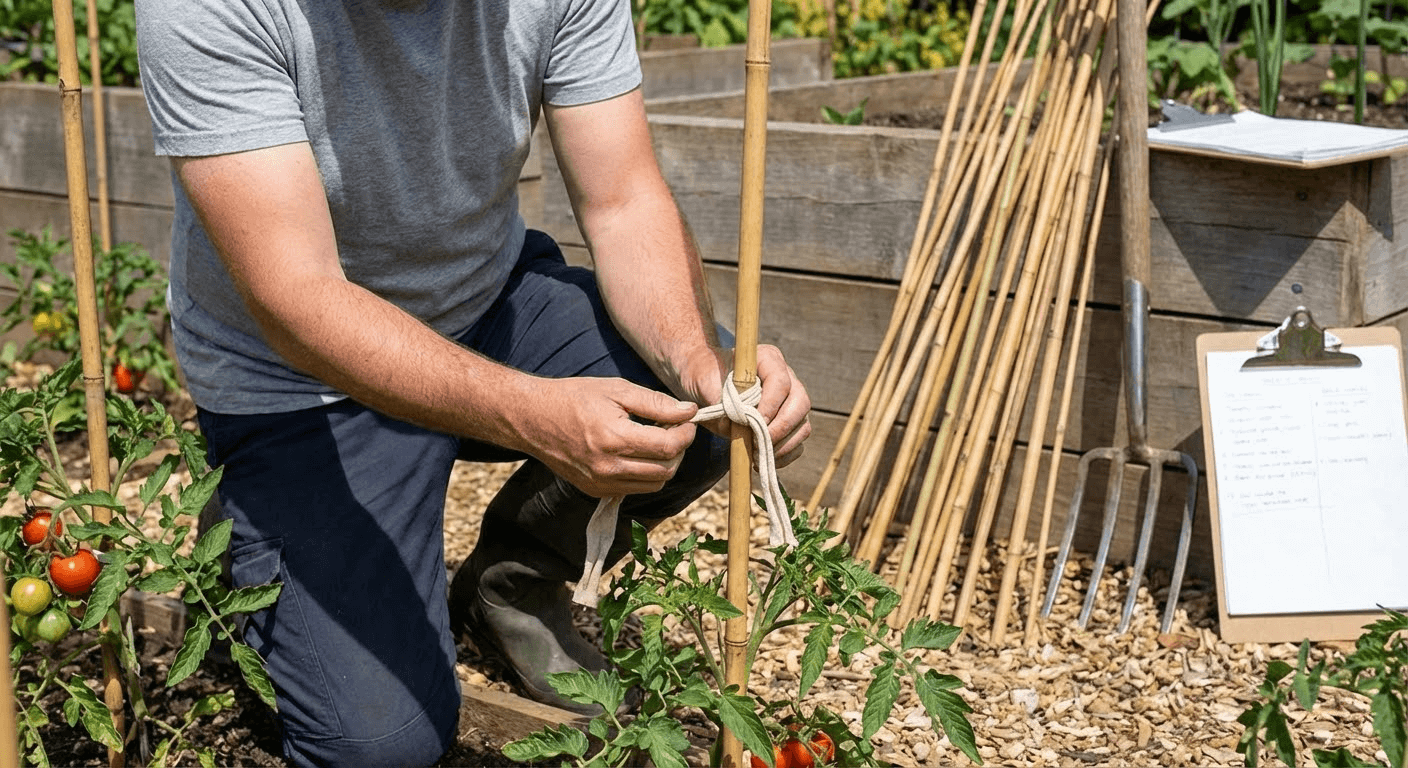
Iowa State Extension’s staking guidance is bluntly practical: tie the plant to the stake using stretch ties or cloth, about every 12 inches, and tie in a loose figure-8 (stake in one loop, stem in the other).
That one technique prevents girdling and reduces stem rub—especially on windy days.
How to Use Bamboo Canes for Gardening
Tomatoes, peppers, eggplant: two proven systems
1) Single-stake (simple, tidy)
-
Set the stake soon after planting.
-
Keep it 3–5 inches from the stem and drive it deep (about one foot for tomatoes).
-
Add a soft tie every ~12 inches of growth using a loose figure-8.
2) Florida weave (built for speed in rows)
Mississippi State Extension describes the Florida Weave as “developed for speed,” driving stakes between each second plant rather than tying each plant individually.
Penn State Extension also notes the Florida/Basket weave is common in the field because it’s labor saving.
Field vignette (what changed my default spec):
On a windy edge bed, I once under-sized canes for late-season tomatoes. After a week of gusts and heavy fruit load, the top third of several canes snapped and ties slid, creating stem rub. The fix that held: move up one diameter class, drive stakes deeper, and switch to consistent figure-8 ties at tighter intervals early. The measurable payoff wasn’t just fewer breakages—it was faster picking because plants stayed upright and lanes stayed open.
Flowers and climbers: stability without strangling
-
Dahlias: three canes in a triangle; tie outward so one tie point never takes all the force.
-
Peas/beans: bamboo teepee or A-frame; add 1–2 horizontal “rungs” for grip.
-
Tall perennials: stake early so you guide growth, not wrestle it later.
Quick structures (where bamboo shines)
-
Teepees (fast, strong, easy to store)
-
Grid trellis (vertical + horizontal lashings)
-
Row supports for netting or light shade cloth
Buying in Bulk: What Pros Should Check
Bulk buying isn’t about “cheap per stick.” It’s about consistent installs and fewer mid-season surprises.
Procurement-grade checklist
-
Length consistency: reduces on-site trimming time
-
Straightness: speeds installs and improves row appearance
-
Surface condition: avoid lots with heavy cracking/splintering
-
Bundle consistency: mixed lengths/diameters cause field improvisation
A practical purchasing strategy: standardize 2–3 core sizes (e.g., 3 ft thin, 5 ft medium, 8 ft thick). Crews learn faster, inventory is cleaner, and you reduce “wrong stake in the wrong place” failures.
Storage and handling
Bamboo is organic—store it like it matters:
-
keep bundles dry, ventilated, and off the ground
-
if canes are muddy, brush clean and let them dry before stacking
That simple routine is repeatedly recommended in care guidance to prevent mold and prolong reuse.
Consolidated sourcing (without the hard sell)
If your orders routinely include stakes, ties, twine, netting, and other garden/farm essentials, consolidating through a broad wholesaler can reduce freight splits and purchasing overhead. This is where “one-stop” suppliers (like Wellco Wholesale’s broader wholesale catalog across garden and farm categories) can be operationally useful—especially for trade customers buying in volume.
Safety, Sustainability, and End-of-Life
Safety basics
-
Gloves when cutting/sanding ends (splinters happen fast)
-
Eye protection when cutting thicker canes
-
Avoid wire directly on stems—ties should be soft and forgiving
Sustainability notes (and the honest limits)
INBAR (the International Bamboo and Rattan Organization) describes bamboo as an excellent renewable resource and a fast-growing alternative to timber.
Recent academic reviews also summarize bamboo’s potential contributions to environmental and economic sustainability across many applications.
Limitations—when bamboo isn’t ideal:
-
storm-prone coastal sites where long-term rigidity is critical
-
permanent installs where multi-year reuse is mandatory
-
situations where repeated wet storage can’t be avoided (accelerates degradation)
End-of-life options: reuse thick canes for multiple seasons when possible, then downshift old canes to markers or short supports before disposal.
Conclusion
Bamboo canes earn their place when you size them like a system: length for height, diameter for load and wind, and depth + figure-8 ties for stem safety. Set stakes early, keep tension up in weave systems, and standardize a small set of sizes so crews (or you) can work faster with fewer failures.
CTA: pick your top 10 plants or job sites, assign each to a standard cane size, and document one tie method your whole team uses. Once that’s done, your next bulk order becomes straightforward—and your mid-season “support emergencies” drop sharply.
Frequently Asked Questions
How deep should I drive bamboo canes for tomatoes?
A common extension recommendation is about one foot deep for tomato stakes, placed 3–5 inches from the plant. In loose soil, go deeper within reason or pre-set a pilot hole so the cane doesn’t wobble or split.
How often should I tie plants to a stake?
A practical rule is to add a soft tie roughly every 12 inches of growth. Use a loose figure-8 so the stem can expand without being pinched.
Are thicker bamboo canes always better?
Not always. Thicker canes help in wind or heavy fruit load, but over-sizing can raise costs and slow installs. Match thickness to exposure and plant weight, and keep a “heavy-duty” size reserved for your toughest sites.
What makes a good bulk bundle for professional use?
Look for consistent length, straightness, minimal cracking, and uniform packaging so crews aren’t trimming and sorting on-site. Standardizing 2–3 sizes usually reduces breakage and speeds training.
How do I store bamboo stakes so they last longer?
Keep them dry, ventilated, and off the floor/ground; let dirty canes dry before stacking. That routine helps prevent mold and slows premature deterioration.