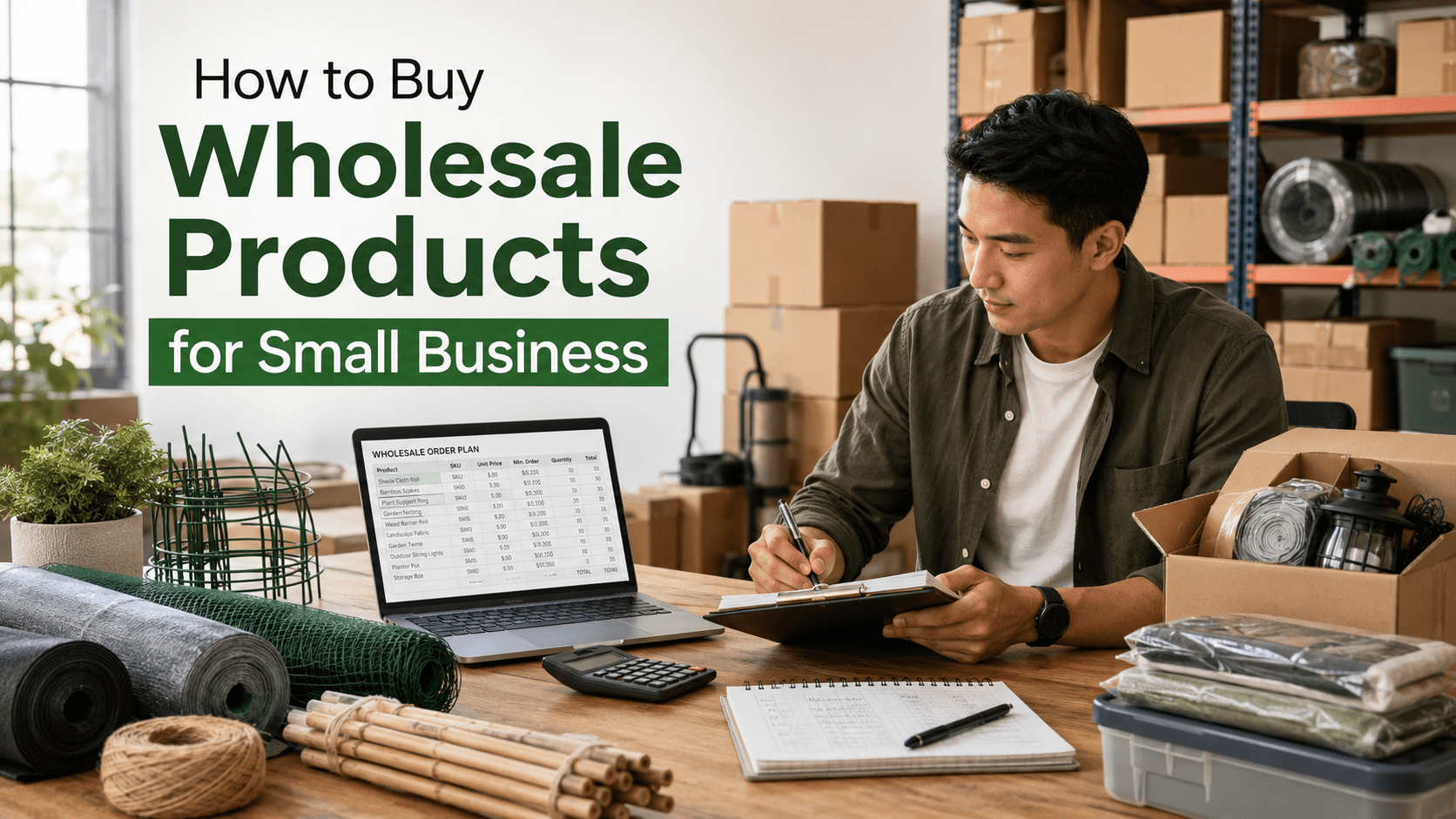
How to Buy Wholesale Products for Small Business
Buying wholesale products can look simple at first. The unit prices seem lower, the product range looks wider, and the profit opportunity feels obvious. Then the real questions appear: How much should you order? Will shipping affect your margin? Can you store the products? What happens if the item sells slowly?
If you run a small business, online store, local shop, landscaping service, farm supply business, or resale project, you need a clear buying process before placing your first order. This guide explains how to buy wholesale products for small business, what to prepare, which supplier terms to compare, and how to reduce risk before scaling.
What Does Buying Wholesale Products Mean?
Buying wholesale products means purchasing goods at lower unit prices from a supplier, distributor, importer, or factory-direct wholesale platform. You may resell those products, use them in your business, or buy supplies at a better cost than standard retail pricing.
For small businesses, wholesale buying can improve margins and make repeat purchasing easier. A garden center may buy plant supports, shade cloth, row cover, or weed barrier for seasonal demand. An online reseller may test patio, outdoor, home, or gardening products before expanding inventory.
How is wholesale buying different from retail buying?
Wholesale buying focuses on lower unit cost, order quantity, shipping terms, resale potential, and repeat supply. Retail buying focuses more on single-item convenience. Small businesses use wholesale suppliers to reduce product cost, test inventory, and build a more reliable supply chain.
The biggest difference is planning. When you buy retail, you usually purchase one item for immediate use. When you buy wholesale, you need to think about your customer, selling price, storage space, packaging, delivery time, and reorder timing.
That is why your first step should be preparation.
What to Prepare Before Buying Wholesale Products
Before comparing suppliers, define what you actually need. Many small business owners lose money because they buy products before confirming demand, storage requirements, and total cost.
Start with your product category. Are you buying garden supplies, patio goods, erosion control products, building materials, home goods, or seasonal items? A focused category makes supplier comparison easier.
Next, set a test budget. A smaller first order lets you check product quality, packaging, delivery speed, and customer response without tying up too much cash.
The table below gives you a practical checklist before placing a wholesale order:
| Preparation Item | What to Check | Why It Matters |
|---|---|---|
| Product category | Choose a focused category such as garden supplies, outdoor goods, or home products | Helps avoid random inventory that is hard to sell |
| Target customer | Define who will buy from you | Guides product size, style, price, and packaging |
| Test budget | Set a first-order spending limit | Reduces cash flow pressure |
| Storage space | Check product size, cartons, and handling needs | Prevents storage problems |
| Selling price | Estimate your retail or project price | Helps calculate margin before ordering |
| Shipping cost | Review delivery cost and free shipping thresholds | Shipping can change your real unit cost |
| Return policy | Check how damaged or unsuitable goods are handled | Reduces risk after delivery |
What should you prepare before buying wholesale products?
You should prepare your product category, target customer, first-order budget, expected selling price, storage plan, shipping cost estimate, and return policy checklist before buying wholesale products. This helps you avoid overbuying and makes it easier to compare suppliers fairly.
For example, a small garden store should not only ask, “How much is this product?” It should also ask, “Can I sell this during the right season, store it safely, and reorder it quickly if demand is strong?”
Good preparation turns wholesale buying into a controlled test.
How to Buy Wholesale Products Step by Step
Once you know what you need, use a simple buying process. This helps you avoid emotional purchasing and keeps your order tied to business goals.
First, choose the right product category. For Wellco Wholesale buyers, common starting categories may include garden supplies, patio and outdoor products, erosion control materials, FRP construction products, and home goods.
Second, compare supplier terms. Look at MOQ, unit cost, shipping threshold, delivery time, return policy, product details, and customer support. A low price only helps when the product arrives reliably and matches your needs.
Third, place a small test order when possible. A test order lets you inspect the product, take your own photos, check packaging, test demand, and decide whether the supplier is suitable for repeat purchasing.
How do small businesses start buying wholesale products?
Small businesses should start by choosing one product category, comparing supplier terms, checking MOQ and shipping costs, then placing a small test order. After reviewing product quality, delivery speed, packaging, and customer demand, they can reorder proven products in larger quantities.
After the first order, track real performance. Which products sold quickly? Which created customer questions? Which had higher packaging or fulfillment costs than expected? Use that information before increasing your order size.
Wholesale buying gets easier when each first order becomes a market test.

Key Factors Small Businesses Should Compare
Price per item matters, but it should never be the only factor. The lowest listed price may become expensive after shipping, storage, returns, slow sales, or inconsistent quality.
Small businesses should compare full buying terms before deciding. This is especially useful for resellers, garden centers, contractors, and small shops that rely on steady supply during seasonal demand.
The table below breaks down the core factors to review:
| Factor | What to Check | Why It Matters |
|---|---|---|
| MOQ | Minimum quantity required per order | Affects cash flow and inventory risk |
| Unit cost | Price per item, roll, pack, or carton | Helps calculate gross margin |
| Shipping policy | Delivery cost, warehouse location, free shipping threshold | Changes total landed cost |
| Product quality | Materials, size, specifications, photos, reviews | Reduces returns and complaints |
| Packaging | Retail-ready packs, bulk cartons, labeling | Affects resale, storage, and fulfillment |
| Reorder availability | Whether the supplier can support repeat orders | Helps avoid stockouts |
| Customer support | Contact options and response speed | Matters when orders need clarification |
A landscaping contractor may prioritize delivery speed and repeat availability. An online reseller may care more about MOQ, packaging size, shipping cost, and whether the product is easy to list online.
How do you know if a wholesale product is profitable?
A wholesale product is profitable when the expected selling price leaves enough margin after product cost, shipping, packaging, platform fees, storage, discounts, and possible returns. Small businesses should calculate total landed cost before ordering, then test demand before buying in larger quantities.
Use this simple formula:
Estimated Profit = Selling Price - Product Cost - Shipping - Packaging - Platform Fees - Return or Discount Allowance
For example, if you buy a product for $12 and expect to sell it for $24, the margin may look healthy at first. But if shipping adds $2, packaging adds $1, platform fees take $3, and you reserve $1 for returns or discounts, your estimated profit becomes $5 per unit.
That may still be worth testing, but the decision should come from real math. Wholesale profit depends on total cost control, not only the listed product price.
Why Low MOQ Matters for Small Businesses
MOQ, or minimum order quantity, can make or break a small business order. A high MOQ may lower the unit price, but it can also trap cash in unsold inventory.
Low MOQ gives you more flexibility. You can test multiple product categories, compare customer demand, and avoid filling your storage space with one slow-moving item.
This is especially useful for seasonal categories. A small retailer may test shade cloth, bamboo stakes, plant covers, weed barrier, or patio products before committing to larger restocking orders.
Can small businesses buy wholesale products without large MOQ?
Yes, small businesses can buy wholesale products without large MOQ when they use suppliers that support low MOQ or 1-piece wholesale pricing. This helps buyers test products, manage cash flow, reduce inventory risk, and expand only after they confirm demand.
Low MOQ also helps online sellers. If you sell through Amazon, eBay, Walmart, Shopify, or a local store, you can test several items and use sales data to decide what deserves a larger reorder.
For small businesses, flexibility can matter as much as unit price.
Buying Wholesale Products from Wellco Wholesale
Once you know your category, budget, and buying criteria, supplier fit becomes the next decision. Wellco Wholesale serves small businesses, resellers, contractors, and individual buyers with factory-direct products across agriculture, gardening, outdoor, home, and building supply categories.
Its 1-piece MOQ can help small buyers test products before committing to larger inventory. Its free shipping over $300 may support mixed restocking orders when you need several categories in one purchase. Its blind drop shipping can be useful for resellers handling direct-to-customer fulfillment. Its OEM/ODM support may help buyers planning private-label products or custom specifications.
Product categories can also match different business needs. Garden supplies such as plant supports, weed barrier, shade cloth, row cover, mulch film, garden netting, and plant covers fit seasonal retail and farm supply demand. Erosion control and FRP construction products may fit contractors and project-based buyers. Patio, outdoor, and home products can support broader resale programs.
Before ordering, confirm current product details, shipping terms, return policy, availability, and any custom requirements. Supplier terms can change, and your best order should match your actual selling plan.
Common Mistakes to Avoid
Many wholesale buying mistakes happen before the order is placed. The most common one is buying too much too soon because the unit price looks attractive.
Another mistake is ignoring total cost. Carton size, delivery location, packaging, marketplace fees, and returns can all reduce your final margin.
Small businesses also forget to check product fit. A product may be popular in general, yet still be wrong for your customer, region, season, or sales channel.
Avoid relying on one product only. A small but balanced product mix gives you more room to test demand, manage cash flow, and adjust based on real sales.
Best Product Categories to Start With
Good wholesale categories usually have clear use cases, repeat demand, and easy customer explanation. The right starting point depends on who you sell to.
Garden supplies fit seasonal retailers, small farms, nurseries, and home gardening customers. Products such as shade cloth, bamboo stakes, fiberglass stakes, row cover, weed barrier, garden netting, and plant covers solve practical growing problems.
Erosion control products fit project buyers, landscaping contractors, and suppliers serving outdoor work. FRP construction products fit buyers who need durable construction-related materials for job sites or resale.
Home and outdoor products can work for broader resale when you want items with everyday appeal. If you sell online, lightweight and easy-to-ship products may be easier to test first.
Start with the category your customers already understand, then expand after you see repeat demand.
Conclusion
Buying wholesale products for a small business works best when you follow a repeatable process.
Choose a focused product category before browsing.
Calculate total landed cost, not just unit price.
Use low MOQ or 1-piece wholesale options to test demand first.
Compare supplier terms, shipping policy, packaging, and reorder reliability.
Scale only after a product proves it can sell with healthy margin.
If you are ready to test wholesale products with flexible ordering, start by browsing relevant categories and building a small, practical first order.
[Browse Wellco Wholesale's full range and request a bulk quote →]