
Double Sided Reflective Foil Insulation: Buyer Guide
Walk into a metal shed at 4 p.m. in midsummer and you can feel heat radiating off the roof like a broiler. That discomfort often isn’t just “hot air”—it’s radiant heat pouring in from sun-baked surfaces. Double sided reflective foil insulation can be a fast, practical tool to reduce that radiant load when the assembly is built for it. When it’s installed wrong (usually with no air space), it becomes an expensive shiny layer with disappointing results.
This article is for trade and bulk buyers—contractors, agricultural operators, greenhouse builders, landscapers, and light-building crews—plus serious DIYers who want pro-level outcomes. You’ll get a clear “when it works” decision guide, what specs matter for purchasing, and installation details that actually control performance.
Who / How / Why (Transparency)
-
Who wrote this: A practical buying-and-installation guide for pros and bulk purchasers.
-
How it was built: Based on building-science fundamentals plus common jobsite failure modes (air-gap loss, seam leakage, moisture traps).
-
Why it exists: To help you pick the right product and avoid the install mistakes that erase the benefit.
As a factory-direct wholesaler serving agricultural, garden, landscaping, and light building supply buyers, Wellco Wholesale often supports bulk customers who want to standardize materials (roll sizes, tapes, fasteners) across multiple sites and keep procurement simple.
What double sided reflective foil insulation is (and how it works)
Double sided reflective foil insulation is typically low-emissivity (low-e) foil on both sides of a core layer (bubble, foam, or reinforced scrim). Its main job is to reduce radiant heat transfer—infrared energy that moves from a hot surface to cooler surfaces.
Three heat moves matter on real projects:
-
Radiant heat: infrared energy (what you “feel” from a hot roof).
-
Conductive heat: heat moving through direct contact (metal → wood → interior).
-
Convective heat: heat moved by airflow (leaks, drafts, venting).
Here’s the performance hinge: foil needs an adjacent air space to act like a radiant barrier. Without that air space, the reflective layer can’t “see” the radiant energy properly and much of the benefit drops away—an emphasis echoed in university extension guidance.
Common constructions (and how to pick between them)
Foil–bubble–foil
-
Best when you want light weight, fast coverage, and easy handling.
-
Good for metal buildings, garages, basic agricultural structures, and some duct/door applications.
Foil–foam–foil
-
Often feels stiffer and can be easier to keep flat.
-
Useful where a slightly more rigid product helps installers maintain consistent spacing.
Foil + reinforced scrim/kraft laminates
-
More durable and tear-resistant for high-speed crews and staple-heavy installs.
-
A good choice when you expect frequent handling, tensioning, or long runs.
If you’re buying in bulk, durability is a money question: fewer tears and do-overs means fewer labor hours lost.
Where it performs best—and where it’s oversold
Best-fit uses
-
Metal shops, pole barns, and agricultural storage buildings
-
Rooflines/attic-side radiant barriers (especially where cooling dominates)
-
Duct runs in hot attics
-
Garage doors and equipment enclosures
Where it’s oversold
-
As a standalone replacement for bulk insulation in cold climates. The U.S. Department of Energy notes radiant barriers are typically more beneficial in hot, sunny climates, and in cooler climates it’s often more cost-effective to add conventional thermal insulation.
Key benefits for trade buyers and bulk projects
Double-sided reflective foil products win work orders when they solve a real problem: cutting radiant load quickly while staying easy to install at scale.
The performance gains you can expect
DOE summarizes that some studies show radiant barriers can reduce cooling costs about 5%–10% in warm, sunny climates—a realistic, not-hype expectation.
A Florida Solar Energy Center primer suggests 8%–12% annual cooling savings can be reasonable for attic radiant barriers in certain conditions (with results varying by home/roof/duct setup).
Those numbers won’t apply to every building type. What often shows up faster than a bill change is comfort: less “radiant sting” near ceilings and hot-facing walls.
Jobsite advantages that matter
-
Speed: large-area coverage with fewer seams than boards
-
Handling: lighter overhead work; less fatigue over a day
-
Clean install: no fibers, no settling, fewer cleanup steps
-
Phasing: useful when you need immediate improvement before a full interior finish
Experience mini story: the troubleshooting sequence that changed results
A crew installed double-sided foil under a metal roof and reported “no difference.” The symptoms were classic: the interior still felt like heat was pouring in, and the roofline was punishing to work under.
Diagnosis: The foil was pulled tight and then compressed by strapping—effectively killing the air space.
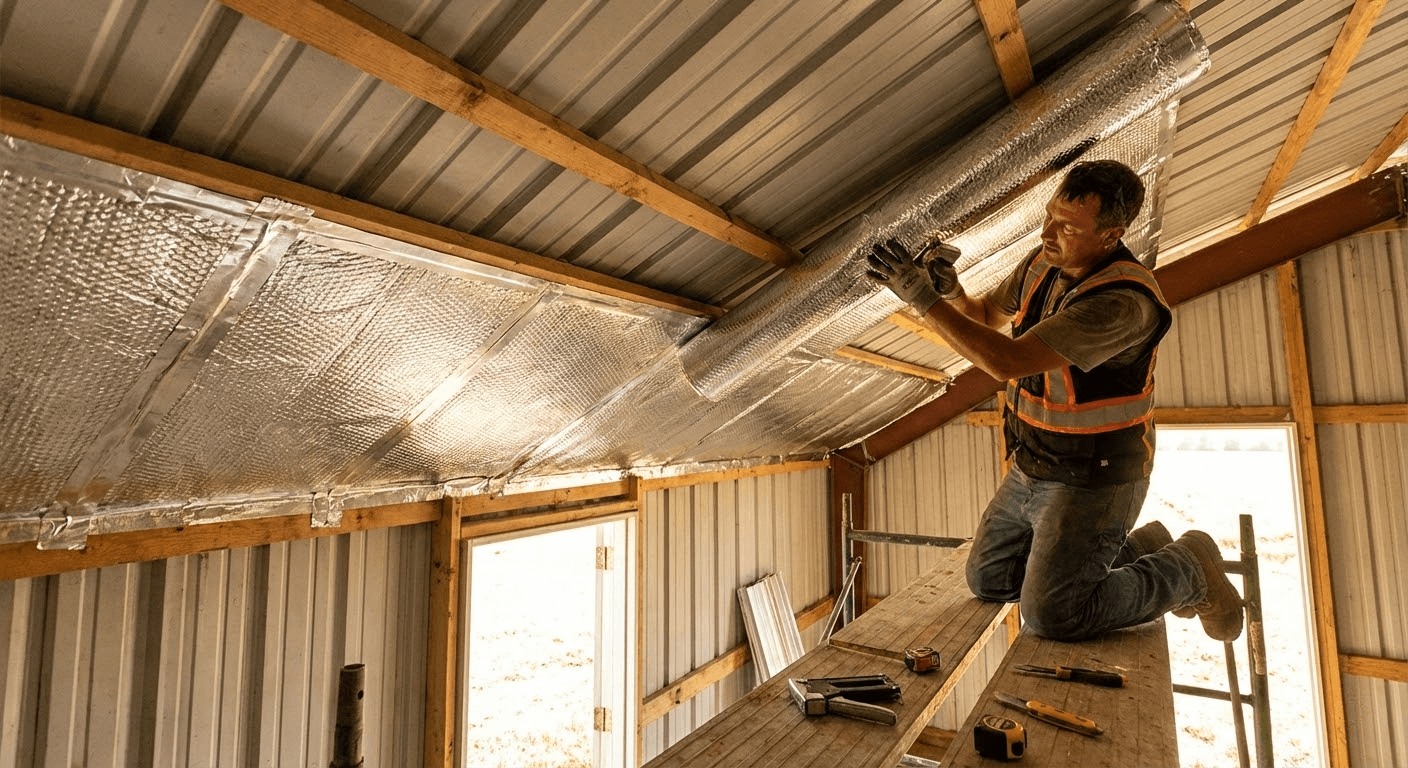
Fix: Add simple furring/stand-offs to re-establish a consistent gap; tape key seams to reduce unwanted airflow across the reflective face.
Result: The building still got warm (it’s a metal building), but the “radiant blast” at head height eased noticeably, and fans became supplemental instead of mandatory.
Same product. Different assembly.
How to choose the right product for your application
Instead of shopping by marketing claims, shop by assembly and use case.
A quick decision guide (what to use where)
Metal shop / pole barn (roof focus)
-
Goal: reduce radiant heat from roof panels.
-
Choose: reinforced options if crews install fast; prioritize roll width to reduce seams.
-
Must-have: a maintained air space facing the hot roof deck side.
Attic radiant barrier (with or without ducts)
-
Goal: reduce radiant load into attic and onto ductwork.
-
Choose: products intended for attic/roofline configurations.
-
Pay attention to dust exposure (see installation notes).
Greenhouse or sun-facing wall exposure
-
Goal: manage intense solar gain on a specific surface.
-
Choose: durable laminates if there’s frequent handling or contact.
-
Confirm you’re not creating a moisture trap in high-humidity environments.
Equipment enclosure / garage door
-
Goal: reduce radiant swing and surface temperatures.
-
Choose: flexible products that conform well; emphasize adhesion/fastening method.
ENERGY STAR has also discussed radiant barriers as an option for attics (often tied to ducts in attic spaces) in specific climate contexts—another cue that “where and how” matters more than generic claims.
R-value claims: what they mean in the real world
You’ll see “effective R” numbers. Here’s the safe way to interpret them:
-
Reflective systems can have strong assembly performance—but only under the specified air-space conditions.
-
If airflow, compression, or missing gaps change the assembly, performance changes.
That’s why application guides often list air-space requirements for specific claimed values.
Procurement specs that actually save headaches
For bulk purchasing, prioritize:
-
Roll size standardization: fewer SKUs across sites
-
Reinforcement and tear resistance: reduces waste and rework
-
Documentation: product data sheets, tested claims, installation instructions
-
Packaging/palletization: avoids crushed rolls and jobsite damage
-
Accessory planning: compatible foil tape, fasteners, furring/stand-offs
This is where a broad-line supplier can help as a value-add: buyers often want insulation rolls plus the right tapes and fastening supplies in one consolidated purchase order. Wellco Wholesale’s one-stop wholesale positioning fits that workflow without forcing a one-material-fits-all decision.
Installation that makes or breaks performance
If you care about results, the install details are the product.
The golden rule: keep an air gap
Reflective foil works when it faces an air space. Without it, the reflective surface can’t do the job it’s designed for—an emphasis repeated in extension guidance.
A broader research review shared via industry/ASHRAE context also discusses common radiant barrier configurations (like stapled-to-rafters) that create the needed air space.
Step-by-step install (repeatable, crew-friendly)
-
Map the air space
-
Decide which side of the foil will face a stable air gap after finishing.
-
-
Dry-fit your runs
-
Confirm overlaps, penetrations, and where seams will land.
-
-
Fasten without crushing
-
Staples/fasteners should hold it flat, not compress it into the substrate.
-
-
Seal seams where appropriate
-
Tape seams when you’re relying on a more controlled air space and want to limit air wash.
-
-
Detail edges and penetrations
-
Neat cuts; tape where it supports the assembly’s airflow plan.
-
-
Protect reflectivity
-
Dust and grime reduce reflectivity; avoid leaving the reflective face where it will quickly load up with debris.
-
On-site “what I check” checklist (Experience)
-
Can I slide a hand behind the foil and feel a consistent gap?
-
Are seams taped where airflow would short-circuit the assembly?
-
Did strapping or sheathing pinch the foil tight?
-
Are there obvious paths for wind to wash across the reflective face?
-
Are we trapping moisture between two vapor-tight layers?
Limitations, moisture, and safety considerations
This is where trust gets earned—reflective products are useful, but not magic.
Limitations
-
Not a full substitute for bulk insulation in heating-dominated climates. DOE explicitly frames radiant barriers as more effective in hot, sunny climates and often secondary to adding conventional insulation elsewhere.
-
Performance depends on maintaining the air gap and minimizing uncontrolled airflow in the wrong places.
Moisture and condensation guardrails
-
Don’t create a “moisture sandwich” (low-perm layers on both sides of a cavity) without a plan for drying.
-
In humid agricultural and greenhouse contexts, be especially careful about where vapor can escape and where condensation might form.
-
If you’re unsure, consult a local building professional familiar with your climate and assembly.
Safety and code notes
-
Use gloves/eye protection; metal edges can be razor-sharp.
-
Keep clear of wiring; avoid stapling into unknown electrical runs.
-
Fire ratings and code requirements vary—verify the product and assembly meet local rules for your building type and occupancy.
Cost, ROI, and real-world use cases
Reflective foil insulation tends to pencil out when it solves a single dominant problem: radiant gain.
When it’s most likely to pay off
-
Metal buildings and high-solar exposures
-
Cooling-dominated climates and seasonal peak-heat periods
-
Intermittently used spaces where comfort gains matter immediately
-
Attics with ductwork (depending on climate and configuration)
As a reality check, think “single-digit to low-double-digit cooling impact,” not a complete envelope overhaul—aligned with DOE’s summary ranges.
Bulk quantity estimating (simple, accurate enough for ordering)
-
Measure target area (sq ft).
-
Add 5%–10% waste for overlaps, cuts, and penetrations.
-
Add seam overlap allowance for long runs.
-
Include accessories: tape, fasteners, and any furring/stand-offs needed to preserve air space.
Example:
A 30' × 40' roof section is 1,200 sq ft. Add 8% waste → 1,296 sq ft.
If a roll covers 200 sq ft: 1,296 / 200 = 6.48 → order 7 rolls, plus tape and fasteners.
Conclusion
Double sided reflective foil insulation is a high-leverage material when you treat it as what it is: a radiant-control layer that needs air space. Pick the construction that fits your crews and environment (bubble vs foam vs reinforced), be cautious with “effective R” claims that don’t specify installation conditions, and install with the air gap and seam detailing that unlock performance.
If you’re outfitting multiple sites, standardizing roll sizes and accessory kits (tape, fasteners, furring) can reduce mistakes and keep installs consistent. For bulk buyers sourcing agricultural, garden, landscaping, and light building supplies, using a one-stop wholesaler like Wellco Wholesale can simplify procurement while you focus on getting the assembly right.
Frequently Asked Questions
Does double sided reflective foil insulation work without an air gap?
It usually underperforms without an adjacent air space because the reflective surface can’t reduce radiant transfer effectively. If the foil is pressed tight between solid layers, you’re largely losing the radiant-barrier benefit.
Can this replace fiberglass or spray foam in cold climates?
Not typically. Reflective products help most with radiant heat in sunny, cooling-dominated conditions, while cold-climate performance usually depends on conventional thermal insulation for conductive heat loss.
What’s the difference between foil-bubble and foil-foam products?
Foil-bubble options tend to be lighter and very easy to handle, while foil-foam can be a bit stiffer and may stay flatter during installation. Reinforced laminates can improve tear resistance for faster crews and longer runs.
Will dust or dirt reduce performance?
Yes—dust on the reflective face reduces reflectivity over time. In attics or dusty environments, plan placement and detailing so the foil surface stays as clean as possible.
What should bulk buyers order besides the rolls?
Plan for compatible foil tape, appropriate fasteners, and (often) furring/stand-offs to maintain a consistent air space. Ordering accessories as a set reduces jobsite improvisation and helps keep installs repeatable.