
Where to Buy Acoustic Panels: Best Options in 2026
Searching where to buy acoustic panels is confusing because a lot of products are “decor panels” pretending to be acoustics. Real panels can reduce echo and make speech clearer—but only when the specs and placement match your room.
This guide breaks down the best places to buy in 2026, how to verify claims, and what’s worth paying for. If you purchase for projects or in bulk, wholesale sourcing can also simplify procurement; Wellco Wholesale positions itself as a factory-direct wholesaler across categories for trade buyers who want consolidated purchasing.
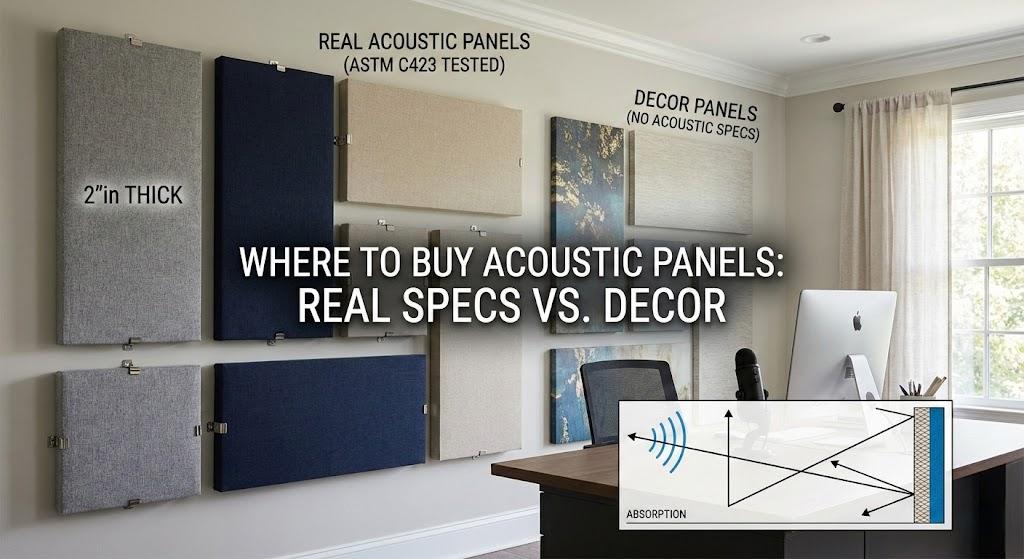
Where to Buy Acoustic Panels: Best Options in 2026
Online marketplaces (best for quick testing)
Great for small test orders, risky for large orders unless the listing has real documentation. A quick check: NRC is commonly reported as an average of absorption at 250, 500, 1,000, and 2,000 Hz.
Look for:
-
material + thickness (2-inch fabric-wrapped panels are a common baseline)
-
mounting method (clips/rails are easier to adjust than glue)
-
clear return and shipping-damage policy
Direct from manufacturers (best for consistency)
Manufacturers usually win on repeatability and paperwork: test reports, build consistency, warranties, and customization. If they can’t tell you what test method supports their numbers, treat the spec as marketing.
Local pro audio / building suppliers (best for seeing it in person)
You can inspect rigidity, fabric, edge finishing, and hardware before buying. Ask for the absorption test method; ASTM C423 measures sound absorption in a reverberation room using decay rate.
Wholesale suppliers (best for multi-room and trade)
Best when you need repeatable specs across many rooms (contractors, facilities, resellers). A broad-line wholesaler can reduce vendor sprawl; that’s the niche Wellco Wholesale aims at with its one-stop wholesale positioning.
How to Choose the Right Acoustic Panels (Not Just “Any Panel”)
Echo control vs soundproofing
Acoustic panels treat reflections and reverberation inside the room. Soundproofing is stopping sound from traveling between rooms. GIK puts it bluntly: “Soundproofing is preventing sound from traveling outside (or bleeding into) the space.”
Two quick scenarios:
-
Glassy home office: start with panels behind the screen + behind your chair, then do a 10-second voice memo (same spot) before/after to hear the difference.
-
Small meeting room: prioritize coverage near talkers plus a ceiling element if the ceiling is hard.
Specs that matter (and how to verify them)
Testing: ASTM C423 is a common absorption test reference for panels; it measures absorption in a reverberation room via decay rate.
Thickness: 2-inch panels are a reliable starting point for speech/echo control; an air gap can improve performance without going thicker.
Fire rating (commercial installs): ASTM E84 reports Flame Spread Index (FSI) and Smoke Developed Index (SDI). Many U.S. interior-finish references describe Class A as FSI 0–25 and SDI 0–450—confirm local requirements.
Verification checklist (ask before a big order):
-
test standard + report summary (ASTM C423)
-
how the product was mounted during testing
-
fire docs (if needed) referencing ASTM E84
-
returns + shipping damage policy
How Much Should You Pay (and What Drives Price)
Acoustic wall panels span a wide materials range—roughly $2 to $17 per square foot depending on type and quality. As a second reference point, HomeAdvisor lists “textured acoustic panels” around $2 to $5 per square foot in its material examples.
What usually drives cost up (and can still be worth it):
-
thicker cores and better low-frequency performance
-
cleaner mounting systems and removable hardware
-
durable fabrics for high-traffic spaces
Real-World Buying Scenarios (Anonymized Case Studies)
A practical target for speech spaces: Biamp notes that “a typical small conference room or classroom should have an RT60 of around 0.4 to 0.6 seconds.”
Case study 1: Home office for video calls
Problem: “My voice sounds boxy and echo-y.”
Fix: started with four 2-inch panels (behind monitor, behind chair, plus two side-wall reflections), mounted so placement could be adjusted. Result: noticeably less “ring” on voice recordings and less fatigue in long calls.
Case study 2: Small meeting room that still felt loud
Problem: treatment was installed, but only a small portion of wall area was covered.
Fix: increased total treated surface area in reflection-heavy zones (back wall + near talkers) instead of swapping brands. The biggest improvement came from coverage and placement, not chasing a slightly higher NRC number.
Conclusion
To decide where to buy acoustic panels, match the seller to your needs:
-
marketplaces for quick tests (only scale when documentation is solid)
-
manufacturers for predictable performance and paperwork
-
local suppliers for hands-on inspection
-
wholesale for multi-room projects and trade purchasing (where a one-stop supplier like Wellco Wholesale can fit)
If the goal is clearer conversation, using an RT60 benchmark around 0.4–0.6 seconds is a helpful sanity check for small rooms.
Frequently Asked Questions
Are acoustic panels the same as soundproofing?
No—panels treat reflections and reverberation inside a room, while soundproofing is about blocking sound transmission between spaces.
What NRC should I look for?
Use NRC to compare products, not as a promise. It’s commonly summarized from absorption at 250, 500, 1,000, and 2,000 Hz, which aligns with speech-heavy frequencies.
Do I need fire-rated panels?
If the install is commercial or inspected, you may need documentation tied to ASTM E84 (flame spread and smoke development). Check local code requirements.
What’s the safest way to buy online?
Ask for the test standard and a short report summary (ASTM C423), confirm how testing was mounted, and verify returns/shipping-damage terms before scaling a large order.