
Steel Rebar Weight Chart & Calculator (T10, Y12, Y16, Y25) - Per Meter
Quick Answer: If you are looking for the standard weight of steel rebar per meter (including common sizes like T10, Y12, Y16), please refer to the Quick Reference Chart below immediately. For manual calculation formulas and detailed guides, scroll further down.
Quick Reference: Steel Rebar Weight Chart (Metric & Imperial)
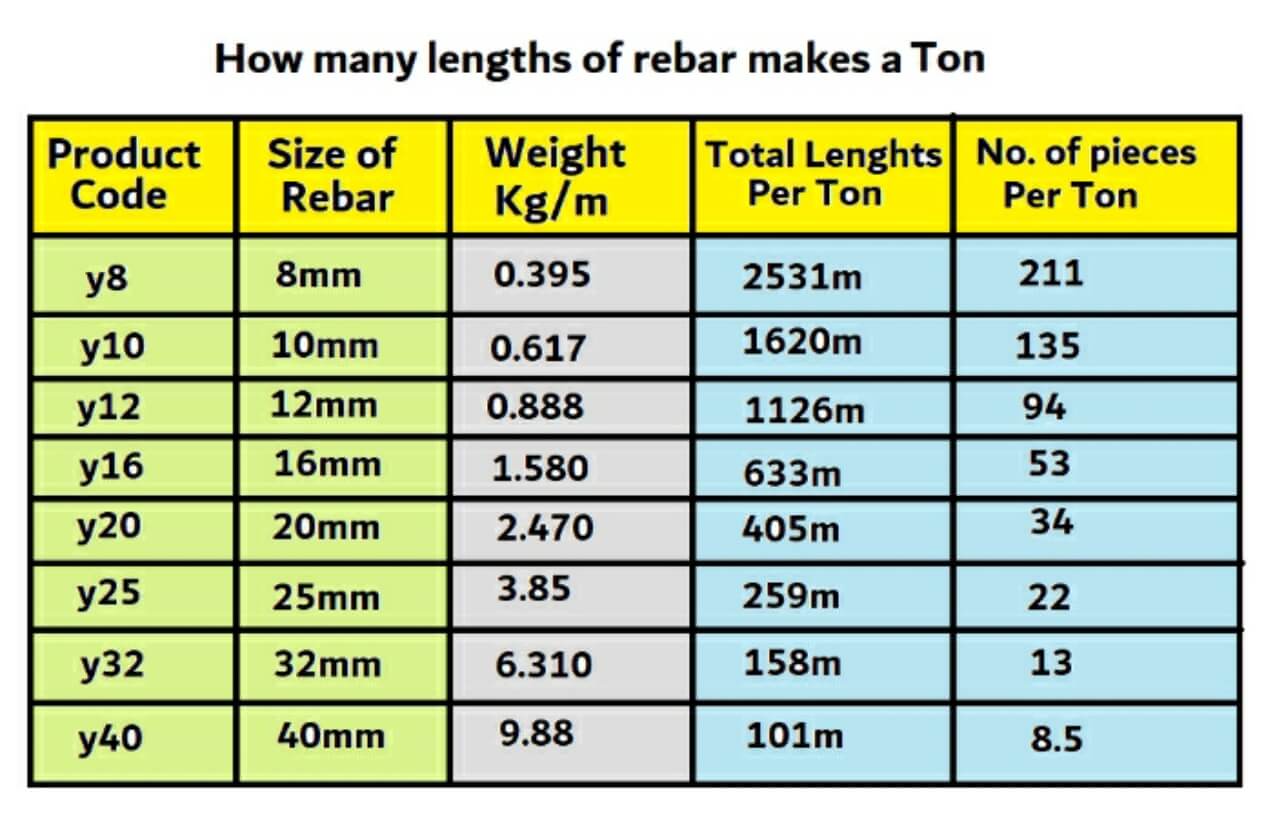
This chart covers the most searched reinforcement bar sizes including T10, Y12, and Y16.
| Size Code (Metric) |
Diameter (mm) |
Weight (kg/m) |
Weight (lb/ft) |
|---|---|---|---|
| T6 / Y6 | 6 mm | 0.222 | 0.149 |
| T8 / Y8 | 8 mm | 0.395 | 0.265 |
| T10 / Y10 | 10 mm | 0.617 | 0.414 |
| T12 / Y12 | 12 mm | 0.888 | 0.597 |
| T16 / Y16 | 16 mm | 1.580 | 1.061 |
| T20 / Y20 | 20 mm | 2.470 | 1.660 |
| T25 / Y25 | 25 mm | 3.850 | 2.580 |
| T32 / Y32 | 32 mm | 6.310 | 4.240 |
Note: The "T" and "Y" prefixes typically denote High Yield Steel, which is the standard for most construction projects today.
How to Calculate Steel Rebar Weight (Formula)
If you need to calculate the weight for a size not listed above, or just want to understand the math, here is the standard formula used by engineers.
The weight of steel rebar per meter is calculated using this formula:

Simplified Formula (Industry Standard):
Weight (kg/m) = (D² / 162)
Where D is the Diameter of the rebar in millimeters (mm).
Example Calculation for Y12 Rebar:
For a steel rebar with a diameter of 12 mm:
- 12 x 12 = 144
- 144 / 162 = 0.888 kg/m

What is Steel Rebar and Why Weight Matters?
Steel rebar (reinforcing bar) acts as a tension device in reinforced concrete and masonry structures, helping to hold the concrete in compression. It comes in various grades and sizes, typically categorized by diameter (e.g., 10mm, 12mm, 16mm).
Why accurate weight calculation is crucial:
- Cost Estimation: Rebar is often sold by weight (tonnage). Knowing the weight per meter allows for precise budget planning.
- Logistics: Helps in calculating shipping loads to ensure trucks are not overloaded.
- Structural Integrity: Ensures the correct amount of steel is used to meet building safety codes.
Factors Affecting Rebar Weight
- Material Density: Standard steel density is approx. 7850 kg/m³.
- Manufacturing Tolerances: Slight variations may occur depending on the manufacturer and rolling process.
Conclusion
Whether you are estimating a project or checking load limits, using the standard rebar weight chart is usually the fastest method. For specific engineering needs, the D²/162 formula will always give you the precise weight per meter.